THANKS TO OUR SPONSOR!

THANKS TO OUR SPONSOR!
Your Ad here
Be sure to sign up for the weekly RV Travel Newsletter, published continuously every Saturday since 2001. NOTE By subscribing to RVTravel you will get info on the newest post on RV Tire Safety too
. Click here.
Huge RV parts & accessories store!
You have never seen so many RV parts and accessories in one place! And, Wow! Check out those low prices! Click to shop or browse!
Showing posts with label TPMS. Show all posts

Friday, November 12, 2021

Are IR guns good for detecting low inflation in tires?

 Comment of Facebook about RV tires

"I carry a heat gun with me. When I stop I check all tires. If one is a lot hotter than the rest I have a problem."

and another

"A cheap harbor freight gun is a good investment. We carry two when I tow my boat to the keys. Each stop my buddy and I have a gun in each door. We each shoot all four wheels then compare noted about what we got as far as readings."

 My response:

As a tire engineer I can advise that IR guns are OK for checking the temperature of metal items such as wheels, hubs or brake drums that conduct heat but rubber is an insulator and very poor conductor of heat so no IR hand gun I know of can detect a meaningful temperature at a rest stop as it isn't the average temperature of a tire that can result in a failure but a spot, maybe smaller than a quarter that you have to worry about. What testing have you done to learn that exact spot over the entire surface of your tires?

The hottest location (most likely to fail or cause problems is also about 1/4" deep inside the structure). Heat is the result of running overloaded or under-inflated. Scale measurement is the only reliable way to know if you are overloaded. Pressure readings are the only reliable way for a consumer to know if they are running under-inflated. You can pick up a nail or cut or have a leaking valve and be underinflated within a few minutes and have a failure a few miles later. The tire I covered in my detailed post where I did a visual "Autopsy"reportedly had it's air pressure checked just 50 miles before the catastrophic "Blowout" run low flex failure. A leaking valve core from improper seating is one possible reason for the air loss the led to the failure. A TPMS is the only reliable way to know the actual running pressure unless you stop every 5 to 10 minutes and check with a gauge and confirm your valve core has properly sealed after you check the pressure. A TPMS can even sometimes warn of brake or bearing problems because the heat is transferred through the metal parts to the metal base of the TPM sensor. 

I do think these low cost temperature sensors have other uses such as checking the temperature of your furnace output or confirming the electrical connections in your 'fuse box" are not getting  overheated. Even the heating element in you absorption refrigerator can be checked. I did use my IR gun to check the surface temperature of my tires when I did my test on tire covers but running tires have a wide range of temperatures as seen here with the output from a $10,000 IR camera. Note the wide range of operating temperatures (80F to 130F) in close proximity ( 0.10") when the passenger tire was run with 27 psi.

 
It only takes a few seconds for the surface temperature to drop significantly which would be less time than it takes you to come to a stop in a rest area so your readings would not reflect the important temperatures near the tire hot spot.


##RVT1026

Friday, August 14, 2020

Does your tire dealer know what they are doing?

Just got this message from a reader.

"I just replaced 6 235/80R 22.5 XRV Michelin tires on my 2013 Monaco Monarch Class A Motor home. The dealer installed, balancing bead bags and new valve stems. I have good access to all valve stems now and have an after market TPMS. A couple of the rears were below the 95 Pound alarm point when cold and I decided to add air. When I removed the TPMS sensors, the valve stem seats leaked on three of six tires. I replaced the faulty valve stem inserts, completed pressure checks and all is well. I heard from one of my friends that the bead bags are causing the valve stem seat to fail and I understand there are redesigned valve stem seats that solves this issue. Can you comment?"

I responded:
The dealer that installed the "balance" stuff should have also installed the special valve stem/core air filters. Powder from beads can get into both the core and the TPM sensor and make them malfunction.

Bolt-in valve stems have a rubber insert on the air chamber side and a large metal washer on the outside. There is a torque spec on the bolt in valves. This blog post, covers valve stems of different types and has the torque spec for the bolt in nuts.
 
By "stem inserts" do you mean the valve core? Every valve stem I have ever seen comes with a new core. The only reason for them to leak is some "stuff" got into the new core and most likely was from the balance stuff.

This makes me wonder if the dealer was just interested in selling you the balance beads but didn't want to kill the sale with an increased cost for the valve air filters.  OR He didn't know that filters were needed when you put "stuff" inside a tire.

Also did the dealer give you a written tire warrantee that covered the use of the balance stuff? 

##RVT961

Friday, July 24, 2020

One tire fails. What about it's "mate"?

Had a question from a friend about replacing both tires when one failed on the same side of the RV. 

 In Motorhomes with "Dual" tires (side by side) in the rear and you do not get the early warning from TPMS of air loss, you need to seriously consider replacing the "un-failed tire" because when it's "mate" failed the un-failed tire was overloaded by 100% for some unknown number of miles. 
You can always take the un-failed tire to a dealer, for that brand of tire, and have it inspected inside & out, and if ruled OK, in writing, by the dealer, you could keep the tire as a spare.
However, if it ran some unknown number of miles at 100% overload, I would not even trust it as a spare. 

 Now in the case of a multi-axle RV trailer (tandem axle) and one tire failed and again you were not running a TPMS to get an advanced warning, we need to consider what happened to the load on that side of the trailer. Wouldn't all the load from that end of the axle with the failed tire transfer to the un-failed tire on that side of the trailer? This transfer would be transferred through the springs and the link between the axles. The load supported by the "failed" tire doesn't simply evaporate, does it? It has to be taken up by the un-failed tire on that side of the trailer.

So again that tire should be removed, inspected, and replaced as with the Motorhome example. It might be OK to keep as an emergency spare but only used with great caution and only if inspected and judged OK by a dealer of that brand of tire.


This is one of the things people do not think of when considering running TPMS. If you get advance warning of air loss in one tire in a "Dual" or "Tandem" location you not only might save the cost of the punctured tire if it was caught soon enough to be repaired but you might even have saved enough by not losing the 2nd tire not to mention avoiding the $Thousands of possible damage to the RV.

 ##RVT959 

Wednesday, June 24, 2020

Valve stems and TPM Sensors

I read the ongoing discussion on what valve stem to use with an external TPMS sensor.

A standard 65 psi max, rubber valve stem is very flexible as seen here.


 Some people think the 80 psi max, "High Pressure"


 HP 600 rubber valve stem is Ok to use with external TPMS sensors but you can see the HP-600 is still flexible.

 Here is proof that an HP rubber stem can fail when a TPM sensor is installed.

IMO staying with any "snap-in" type stem is false economy given the metal bolt-in stems only cost $3 to $4 each. Not all tire stores will have the metal valve stems so check first. if they don't you can get stems at AutoZone, O'Riley's, Advance Auto Parts or NAPA or most any auto parts store or even on Amazon.
They are easy to install too. Don't let the service center tell you installing metal stems is a lot of work.  Watch and you will see.
https://youtu.be/sJB9wPsbBVU


##RVT955


Friday, April 24, 2020

Contain tire Blowout?

Every few months someone posts a question on one of the numerous RV Forums I monitor, asking if it is possible to prevent the damage done to the RV when a tire fails and has a belt separation or comes apart from a sidewall Run Low Flex failure.

 I have previously written on the idea of trying to "contain" tire failure on my blog but for those that missed the information here is a summary and links for more details.

In the tire industry, we have test drums surrounded by steel grating which weighs 6 to 10# per square foot so don't forget you would need a substantial structure to support a 200# - 500# "shield over each tire position. This extra weight would also significantly decrease the amount of "stuff" you can pack into your RV.
 IMO having worked around tire test labs, an effective "shield" on an RV is unlikely to work. I feel that prevention is a much better approach.

To better understand the problem I suggest you review the following.

1. Read this post.

2. This post shows the kind of forces we are talking about.

3. Check out the safety cage around this tire test machine.

4. Buy, program and test a TPMS

5. Every 2,000 miles or annually (whichever comes first) do a "Free Spin" inspection of trailer tires.


Prevention is much better than and less expensive than trying to protect your wheel wells.

Friday, February 28, 2020

YES You do need "Bolt-in" metal valve stems with your TPMS

Story on a Sprinter RV forum.
Reply to posts on TPMS
"My new tire pressure monitoring system just saved our just-completed trip to Florida. Thanks to you all I thought I had, and paid a lot, to Mercedes to replace my rubber valve stems and add metal valve extenders for my sensors. If you remember, I did see the front wheel valves Mercedes did NOT replace with steel. I did get BORG valve stems from ShinyRV.com, as suggested, for the front and my local repair shop installed them. I could not see into the rear dual's to check. Well, you were right, after about 2000 miles into our trip, I turned on the TMPS to check pressures. The warning came up right away on one of the rear tires, 7 PSI. Sure enough, after five hours just off of interstate 75 in Florida, Mercedes had roadside assistance change to the spare (still have warranty). I added some air to the flat tire and soaped the rubber valve to verify that's what caused the leak. It didn't seem like a rub through but I did see cracks (must be from vibration). We drove 160 miles to a tire repair shop in Georgia. They put in small rubber valve stems in the spare and all four rear tires because I couldn't trust the rubber valves. All TPM sensors were removed from the rear wheels. Lesson learned, TIRE PRESSURE MONITORING IS A MUST ALONG WITH STEEL VALVE STEMS. Rubber ones will crack and leak. I will order BORG steel valves for the rear wheels."

I did offer a comment that you need the TPMS on for it to provide a warning and I was a bit concerned about the comment on "turning on the TPMS" to check tire pressure.

I am posting this comment to point out what can happen when you use rubber valve stems and an external TPM sensor.

##RVT937

Friday, December 13, 2019

How I avoid problems with Dualie tire hose extenders.

The key to avoiding problems with a hose or any type of valve extension is to be sure the outer end is

 S O L I D.

Some hose kits come with small brackets that can be pop-riveted to hub cap. Others have brackets that attach to lug nut.
People often fail to support the hose or bracket when checking or adding air. The force needed to get a good air seal is enough to bend or loosen the hose mounts. or they inadvertently twist the hose and end up with a leak where the hose screws onto the metal valve.

You need to hold the outer end of the hose firmly to prevent movement or twisting or you can expect to eventually have problems.
In THIS blog post, you can see my set-up (42,000 mi) w/ no leaks or failures.

Since I run a +10% psi margin over the minimum pressure I need on my Class-C based on 4 corner weights and since I always run TPMS (that I have tested) I simply use the TPMS to tell me the inflation each morning before I start out.
During a cross country trip OH > OR > OH over 7 weeks I only needed to add air once so since I am not messing with the hose extensions, I am not pushing on their mounts or applying a force that might result in a slow leak.

If/when I ever do need to remove a sensor to change a battery or add air, I ALWAYS spritz Windex to check for any leaks after I am done.

##RVT926

Friday, August 2, 2019

What's a good Tire Pressure Monitor System for a Class-A?

Had this question asked on an RV forum I monitor. Thought I would share my answer.
+++++++++++++++
While I don't have a Class-A, other than the length, I'm not sure if any one system is significantly better than another. As long as the system you buy can handle the total number of tires on your coach + toad AND is rated for your tire pressure. Warranty length and service may be the only meaningful difference between some units.
I have done what I think is the only direct real-life comparison of internal vs external system back in 2018 and published the results on my blog.
But some general observations and comments.
IMO User-replaceable batteries are a plus. You can confirm the battery P/N before purchase and check at a grocery store or at Home Depot or Lowes for both price & availability but most are under $2 each and last 1 to 2 years depending on use.  I have found that after 8 to 18 months use, low battery power may contribute to the dropped signal. My solution is to mark the install month year date with Sharpie.
I do like a system with long (Lifetime?) warranty and one that actually has the dealer/distributor attend RV conventions as that means they have people that are not just selling "widgets" on Amazon and probably have a telephone, email, and website.
RE: Repeater. I have listened to the "sales-pitch" from a number of different vendors at FMCA Convention and most will ask about the type & length of coach and offer suggestion to get a repeater or not but I also note that some will offer to send a repeater for just the cost of the repeater if you discover you need one later. Others just include a repeater with all sales just ask and see what they say or offer.
Alarms going off. I have a blog post on how I set my TPMS and haven't had any false alarms with the TireTraker system I purchased in 2009 (I did upgrade to the TT500 in 2018 after I killed the original TT400 monitor by connecting the wrong charger to it. My error not TT)
I have found I do not need a power cord to the monitor on the dash as a single overnight charge is good for weeks of daytime use.
I do shut off the monitor each evening. In the morning I turn it on again and by the time I am done with my coffee all 6 sensors have sent in the baseline pressure so I get a fresh "cold" pressure reading just to keep an eye on things. Do not be confused with the time to establish a signal. As far as I know, sensors only send a signal once every 8 to 15 minutes to conserve battery life. They also will send a Low-Pressure warning within 2 to 4 seconds. Read the literature or ask the dealer to learn what your system timing is.
Maintenance:  I do run a "test" every year to confirm the sensors are still reporting air loss in the first few seconds. The post also covers spare parts I keep on hand.

##RVT908

Friday, March 22, 2019

Valve stems, cores, and caps "Oh My", and how tight is tight enough?


Yes, some rubber valve stems have a metal center and some valves are all metal except for a rubber gasket. The metal part of valves is almost always brass. Sometimes Nickle plated to look like chrome or to match aluminum wheels.


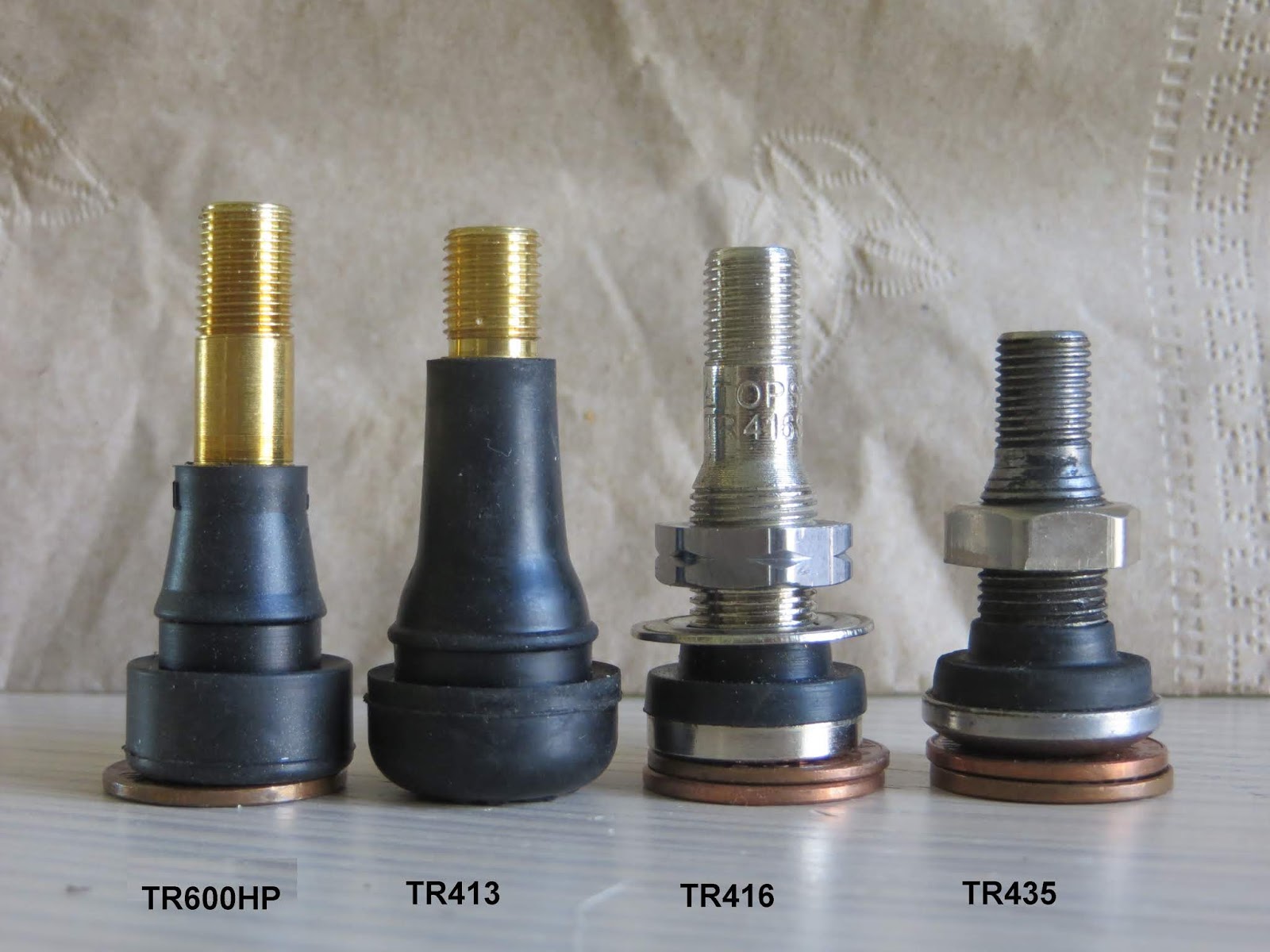
The two valves on the left are "Snap-In" rubber valves.  The two on the right are "Bolt-in" metal stems. By "Snap-In" we mean the valve is installed into the hole in the wheel by pulling on the threaded part of the brass until the small rubber ridge "snaps" through the hole.

The best way to know for sure is to look for a nut that "bolts" the stem to the wheel.  I would suggest a TR416 or similar as seen HERE from Auto Zone.  O'Riley's parts stores have a similar short stem.  You should be able to find similar in almost any auto parts store. These metal stems come in many lengths from less than an inch to 2" or longer (different lengths have different TR part numbers).  The hole in your passenger, trailer or light truck wheel is most likely 7/16"  Old VW wheels were 5/8" All 19.5 and 22.5 wheels should have come with a metal bolt in valves but those use the 5/8" rubber grommet/O-ring. Many metal stems sold at retail, come with two different rubber gaskets, one for each size hole. The gasket is just a snug fit and should just push into the wheel hole.

Note the nut has a torque spec of  25 - 45 INCH Pounds so do not over tighten the nut. I have found that a regular 9/16" wrench is just fine and you do not need a big ratchet wrench to tighten the nut.

Keep the stem short to lower the chance of the TPMS being knocked off if you get near a curb. There are some unique wheels that may require a bit longer stem to allow you to attach your TPM sensor. I suggest you have the sensors available when you install the bolt in stems to confirm sufficient clearance.

The main reason for metal stems when running TPMS is to prevent vibration of the stem which can fatigue the rubber stem.


While you are at the auto parts store be sure you have METAL valve caps. Plastic caps are IMO only good for keeping dirt and small birds out of the valve core area. Metal caps should have rubber "O" rings in them and can retain air if you are not running TPMS. Look in the thread end and you should see the gasket.

Each Fall, when I remove my TPMS for the Winter, I place metal caps on my stems. I will admit that one year I didn't do that and the valve core had a very slow leak but I ended up with a tire being damaged because it lost air over the 7 months between when I parked and when I was getting ready to go traveling.
  
I have a couple of posts that focuses on the valve cores. One on why they leak.

One detail is how to know how tight is enough for your valve cores. Over-tight can cause the small gasket to deform and even split and under-tight will result in a slow leak. After 40 years of installing valve cores I consider my fingers to be close to "calibration" but it would be better if you followed a specific procedure.

I did a test that may help. The spec for valve core torque is  1.5 to 5.0-inch pounds MAX  but I don't expect you to run out and buy a special inch-pound torque wrench as seen here.


To help you I devised this test. Using the test fixture I made when running my TPMS comparison I loosened a core till it leaked as seen here.

 Then using my torque wrench I tightened the core till the leak just stopped. I then continued to tighten the core till I reached about 1.5 Inch Pounds (this was 1/4 turn after the leak stopped) I then continued to tighten the core till I reached 5-inch pounds (This was 3/4 turn after the leak stopped)

  So I would suggest that you can simply tighten a core till the leak stops then rotate 1/2 turn more.

Here are sample core tools.
The one on the left is a "professional" tool but I have also used my home made core tool for many years. This is just an old scrap rubber valve stem with a cap that has the cut-out to fit a core.
I hope this helps you understand a bit more about valves and valve cores.


##RVT889

Friday, January 25, 2019

Can TPMS provide advance warning of a Belt/Tread Separation?

Read the following on a forum for one brand of trailers where they were discussing the advantages of having a TPMS:
Someone said "How do you know if you have picked up a nail, which is leaking air, since your last walk around? A TPMS is like a fuel gauge. You could always dip your fuel tanks at every stop too."  Another reader replied "Great point; I might add, if there is something happening to the tire like tread separation which could lead to a blowout the temp likely would be going up and the alarm would sound and show temp compared to other tires.... I have read here on the Forum and other Forum's several incidents where a blown tire has caused extensive damage. Same if you picked up a nail or something where a "slow leak" might become a fast leak after your back driving on the highway... Like insurance...but, maybe not worth it to some folks."
I then replied:

As a tire engineer, I am sorry to inform you that having a belt separation will probably not generate enough heat to set the TPMS warning off.

TPMS stands for Tire Pressure Monitor System. It does not and for all intents and purposes can not provide advance warning of a tire failure due to belt/tread separation.

Air leaks can cause failures in a few miles as seen in my blog post on Blowout a real-life experience on an Airstream, to after a few hours depending on how fast the leak is. Some TPM offer warning if the pressure drops by just a couple psi in a couple of minutes or less. Some will not warn till you drop 15% to 25% below the cold inflation pressure which means you first have to lose the pressure you gained from normal driving.

I know of no consumer-level device that can advise of a belt separation as separation can take thousands of miles to grow large enough to result in the tire coming apart.

I have posted on this blog on how to do a thorough tire inspection to discover if you have a separation. Even a video and pictures of a tire belt separation before the tire came apart.  I covered the "Why" of tire failures in THIS post. Did you read and understand that information?

Friday, September 14, 2018

Do you have to replace valve stems when installing TPM sensors?

Got this question on an RV forum:
"I understand from the thread that you should use metal tire stems with TPMS caps. The ends of the tire stems on our trailer are metal with the only visible rubber part right where they go through the wheel. I am guessing these are still considered rubber stems and should be replaced prior to installing TPMS?"

"Metal" stems can be a bit misleading as some newer stems may have some brass showing. I posted pictures on THIS post showing standard passenger rubber valve, a "bolt-in" metal valve, and a new style rubber/brass valve.
When it is recommended that "metal" stems be used, what is actually meant is "bolt-in". You will see the nut that retains the bolt-in stem on the outside of the wheel for most of these stems.

The concern is that over time (months or maybe years) the extra weight of TPM external sensors may cause some vibration and movement of the rubber stem body which might result is a failure of the rubber portion of the stem.

I am not aware of any testing done on the new style rubber/brass stems with a TPM sensor screwed on, so I and others are erring on the side of caution when we recommend "bolt-in" metal stems.

Cracking and failure of the rubber part of valve stems is another time & temperature aging thing, just as it is with your tires. You visually inspect your tires monthly, as outlined in your RV  owner's manual, so just include the rubber part of your valves and just as you would replace your tires when signs of significant signs or aging (cracks) are found do the same with your valves. 

You could consider running your current valves until you get new tires and at that point have the bolt in valves installed. In the meantime, I would take a close look at your stems when doing your monthly visual inspection. You can push sideways a bit on the rubber/brass stem and look for any cracks. If you find any, that would mean you need to replace them sooner rather than later.

Friday, August 17, 2018

Internal vs External TPMS comparison Hot ambient

Since March I have been conducting a comparison of a couple different TPM systems. One from TST has internal sensors, as seen here.

Please note this shot shows the TPM sensor and the steel band retainer. I was in the process of removing the extra band material as this is a 16" wheel. A larger wheel would need a longer band.


The other from TireTraker has external sensors that screw onto the end of your metal valve stems. Or as I did on the end of my dual tire extension hoses seen here.


I also had some TST external sensors that mount on valve stems and look very similar to the TireTraker brand sensors.

This is the final post on the direct comparison of different sensor location. I previously posted results HERE but there was a question raised as the internal system was one brand from TST and the External sensors were from TireTraker. We needed to learn if the minor differences were due to the different brand or the different sensor location.

To accomplish this I mixed the external sensor brands and used three external sensors from TST vs three from TireTraker. Here are the numbers.

Ambient was in the upper 80s to lower 90s for this part of the test.

Internal vs External TPMS test results


All temperatures are in °F and pressure in Psi
Internal System.            
Temp.  RF 102   LF  102    RRO  104   RRI  109   LRI   113   LRO  106
Press          69           70                 82              84              84              86

TST External System
TEMP    RF  86                                      RRI   84                         LRO   86
Press           70                                              84                                  86


Second run
Internal System.            
Temp.  RF 108   LF  111    RRO  115   RRI  124  LRI   117   LRO  109
Press         70           71                 84              87              84              87

TST External System
TEMP    RF  79                                      RRI   90                         LRO   82
Press           71                                               86                                    87

Tire Traker External System
TEMP                    LF  78     RRO   100               LRI   91
Press                          70                  82                         83

Now I realize that reading the above doesn't make the differences and similarities obvious or even easy to see so here is a summary of the findings.
TST system  External vs Internal pressure readings are essentially the same
TST system  External temperature readings run 20F to 30F cooler than TST Internal temperatures.

TST system internal sensor pressure vs external sensor pressure readings Tire Traker are essentially the same
TST internal temperatures readings run 15 to 33 (average 25F) hotter than Tire Traker external temps.


Reviewing the above results and the results posted in the July 20 report and the two March reports from tests with Ambient in the 30s and 40s, it is my considered opinion that both TST and TireTraker systems provide similar numbers for inflation pressure and that external sensors report temperatures that are 20F to 30F cooler than internal sensors for both brands.


BOTTOM LINE
Given the above comparison on the data readings, I would consider these two systems a toss-up for reporting the temperature or pressure, as long as you remember that external sensors are being cooled by external ambient so will report 20F to 30F lower temperatures.

There are some differences between the two systems and some of these are subjective. I will cover these differences in a future post.


Friday, July 6, 2018

Are TPMS of much value ?

Some people still question the need or value of using a TPMS. Some claim that checking tire temperature with an IR gun or touch with the back of their hand every two to three hours is sufficient. They seem to forget that it is possible to destroy a tire in as little as 10 minutes.
Others still think they know what an underinflated tire "looks" like but I have repeatedly demonstrated with hundreds of participants at my RV Tire Knowledge Seminars that no one is able to identify the difference between 35 and 14 psi in a P type tire or the difference between 46 and 66 in a LT tire. Some folks just don't feel the cost justifies the value of an advanced warning of an impending tire failure.
Well, I ran across the following post on an RV forum thread on tire failure on an RV.

==============================
With permission of the author:
 FYI....Be maniacal about checking tire pressure and invest in a TPMS system if you have not already.
This past week, two incidents proved that a TPMS (tire pressure monitoring system) investment is worth every penny.

Coming back from a long trip on Memorial day, my caravan friends, who did not have a TPMS on their 5th wheel toy hauler, lost pressure in a rear tire which became overheated and eventually blew on the interstate. The damage the blown tire caused to their meticulously maintained RV added up to $3000 in body work. I hear this is typical...and often at the low end of cost for damage when a tire blows. My buddy has talked about investing in TPMS...but chose not to spend the $. The insurance deductible alone for the damage was $500. Lesson learned.

A few days later, I was back on the interstate headed for a camping trip to the lake with my 5th wheel toy hauler. I have invested in a TPMS....and am so glad I did. At 65mph....all of a sudden the display on my TPM system flashed red and displayed that my right rear tire on the trailer was "leaking". I was impressed that it alerted me when the tire pressure was down only by 2 pounds...and I could see on the display the rate at which it was deflating. This gave me sufficient time to exit the highway, park in a safe place...and not suffer any damage to my RV....let alone save the tire which picked up a screw.

This device is worth its weight in gold....and I highly recommend it to anyone pulling a trailer of any kind. You will never know you a have a problem until it is too late without it. 


==========================

There you have it -- a direct comparison of the value of TPMS vs no TPMS.

Friday, June 29, 2018

TPMS temperature readings. Of little value in my opinion.

A comment on TPMS: As a tire engineer, I see little reason to present the temperature of the sensor. IMO this extra information has some problems.
 1. Tires fail from low inflation primarily due to air leaks (puncture, cut or valve problems) but not from just getting hot. You only get a tire hot from running too fast and/or running to low air pressure. The sensor is not actually reading the temperature of the critical location in the tire as the hottest location is internal to the tire construction and measurement of that location can only be accomplished with a needle probe as done by Race tire Engineers ( I did do that as part of my job once upon a time).
2. The temperature number is distracting and is actually the temperature of the sensor, not the tire and the sensor is cooler than the wheel.
3. The TPMS temperature reading is significantly (25F to maybe 50F ) different i.e. lower than the tire temperature for most applications. More on this temperature difference in a future post. While it is possible for a sensor to report a dragging brake or failing wheel bearing an IR hand gauge is a better tool to use if that is your concern, as the hub will be hotter than the wheel and provide an earlier warning.

##RVT852

Friday, March 16, 2018

How accurate is your TPMS?

I have seen a number of people express some concern about the accuracy of the pressure readings from their TPMS. You can read my previous responses HERE  and HERE

I have also pointed out that the primary purpose or "job" of a TPMS is to warn the driver of a pressure LOSS.

I am inclined to think that some are still concerned with their exact pressure reading. I also have to wonder how some people are comparing various pressure readings reported by their TPMS. If they have external sensors, the simple act of removing and replacing a sensor can allow some air to escape. While I doubt that the small loss of some air will result in a meaningful pressure differential it does add some uncertainty.

So the engineering DNA in me kicked in and I a devised a plan to test 12 sensors. These come from two different companies. One set of 6 external sensors is from Tire Traker and one set of 6 internal sensors is from Truck Systems Technology.

The question is: How do I make the test both fair and useful. I decided to eliminate as many variables as possible and get all 12 readings from the same air chamber at the same time and compare them all against my personal digital hand gauges that I have checked against an ISO certified laboratory gauge.
Note my hand gauge reads to 0.5 psi which is way more precise than anyone needs for checking tires in normal highway use.

Here is the test fixture I made.


It has 6 bolt in valves for mounting the external sensors plus a valve for me to use with my hand gauge. Also since safety is always of concern when dealing with a pressure vessel I added a pop-off valve.  One end of the fixture has a cap that can be removed so I can place the internal TPM sensors inside the 4" tube. It also has a regulated air supply to compensate for the very slow leak around the cap and an analog dial gauge that allows me to constantly, visually monitor the air pressure to ensure the use of my hand gauge does not result in a pressure change that isn't immediately compensated for by the regulated air supply.

Here are the results of my comparison test. The target pressure is 80.0 psi as reported by my handheld digital gauge.

Set A  1 reading of 78 psi,  5 readings of 79 psi
Set B  2 readings of 78, 2 readings of 79 and 2 readings of 80 psi

I also recorded the temperature.
Set A  4 readings of 66 F, one each of 64 and 68F
Set B  4 readings of 69 F  and 2 readings of 68

I do not consider any of the differences in the readings of pressure or temperature to be significant or meaningful for a TPMS.  I would consider the pressure readings from all 12 sensors to essentially be equivalent.
You can learn a bit more about what a "meaningful" measurement is HERE.

Friday, February 2, 2018

Not a "Blowout" but definitely was a Run Low Sidewall Flex failure. No TPMS was cause

Read the following on an RV trailer forum:
"BOOM it happened again, however, this time it was with the upgraded Maxxis tires, seems to me that a lot of these "trailer tires" are just plain garbage. 
The only positive thing I can say is that the Maxxis tires did not blow up like the TowMax tire did thus I suffered zero damage this time, call that a win-win.
All tires were checked prior to departure and filled to 80PSI, less than 20 miles to our destination (220-mile trip) I saw a bit of smoke coming from right side pulled over and the side wall gave out. 
Changed it with the spare Goodyear Marathon that camping world lovingly overcharged me for last year ($197.67 to be exact) and went on my way very slowly. 
Found a tire shop called Gattos in Palm Bay FL that had my size 235/80R16 and installed four new Goodyear Endurance tires (FYI tire shop was way less than camping world by $34 dollars per tire!)
Why 4 you might ask, well it just made sense to me kids, wife & dog in the truck better safe than sorry. Took the three good Maxxis home with me as they look fine, may use one and make a second spare tire. 
Let's hope the Goodyear Endurance tires are as good as they say at least they are made in the USA VS the Marathon that's made in China & had a really bad track record. 
Anyways just sharing my experience will be purchasing a TPMS system very soon before our next trip that's for sure. Any recommendations? Seems many offer a six-tire system all I need is a 4 tire system."


=============
My reply

Sorry to see you had another tire failure but there is no such thing as a "failure-Proof" tire. All tires need to be properly inflated. ALL THE TIME. Not just at the start of a trip.
The pictures provide the evidence with that nice 360 flex that resulted in one side ending up with just the bead area and lower part of the sidewall. This piece of convincing evidence is seen in upper left part of the picture.

I hope you held onto the other 3 tires as there is no reason to expect them to fail as they apparently didn't lose air like the failed tire did.
In case you wonder about my diagnosis you might review THIS blog post where I was provided with a number of sharp pictures of the failed tire.

As covered in THIS post, 99+% of tire failures are due to one of two different causes. Your tire has clear and convincing evidence of failing due to Run Low Flex Failure of the sidewall.

I would strongly suggest a TPMS be installed so you could get advanced warning of air loss.

Note: I have even seen instances where the valve core sticks open and if the valve cap is not metal with an internal "O" ring the tire just takes longer to go flat as plastic caps are really, IMO only reliable at keeping dirt and small birds out of the valve core sealing ring. You might review THIS post on valve cores to understand why metal caps with 'O"rings or TPMS sensors are the only items I consider acceptable to use on the end of a valve stem.


Friday, December 29, 2017

Too much pressure increase

Reading an RV forum thread on TPMS usage. One comment jumped out at me.

"I have a serious concern with the G rated tires on my 5th wheel trailer. When I run the cold max pressure at 110 PSI, I get TPMS readings up to 134 PSI rolling down the road. Lately, I have been running 95 PSI cold and am getting 115-119 PSI rolling. The tires and rims are rated for 110 PSI, I can live with 120 PSI, but the 134 PSI concerns me."


I replied that inflation ratings for wheels are based on a "cold" pressure. Increase in pressure due to operation is considered by manufacturers and I would not be concerned as long as the proper cold inflation is used along with appropriate limits on load and speed.
Tire wording "Max Pressure" can be confusing but in reality the pressure stated on the tire sidewall is the cold pressure needed to support the stated load and that load is the maximum load the tire should be subjected to. I advised the owner that he should NOT underinflate his tires and plan on operation temperature to increase the pressure. "Cold" pressure is the only pressure you should be concerned with.

Tire pressure increases by about 2% for each increase in temperature of 10F. If you don't remember the Science from High School you can read THIS post.. If you are seeing a 21% increase in pressure (110 > 134) that means you are seeing about a 100F increase in internal tire temperature, which I would consider a bit excessive for normal tire operation.

If you are seeing a 25% increase in pressure (95 > 119) then you are getting a 125F increase in temperature which indicates you are working the tires even harder . This extra "work" that is generating a greater temperature increase is not good for long term tire life. You are "aging" the tire rubber faster. Some might want to review this "Key Point" of tire life as covered in THIS post.

I cover these points on Temperature, Inflation and Aging in various posts on my RV tire blog.

Your temperature increase indicates you are possibly overloading your tires and also possibly driving faster than desirable for your tire loading.

You need to confirm your pressure is 110 psi AND that your gauge is giving an accurate reading at that level.

The poster then responded:
"Today drove 250 miles and my 95 PSI tires were running 115-119 PSI and the tire temps were at 20F above out side temp, 50 outside and 71 tire readings. I still contend that 134 PSI is way to dangerous for tires to run on 110 rated tires."

So I responded back:
 Few people realize that the pressure increase as a function of temperature is based on well established and confirmable Physics and that a TPMS is not reading the actual tire temperature  but is actually reading the temperature of the brass valve stem and the metal base of the TPMS itself, which is being cooled by outside air.

Air is a very good insulator and if you think about it, you have a small column of air running up the inside of the valve stem which makes it difficult for the heat to travel up the center of the stem and past the valve core itself all the while the valve is moving rapidly around being cooled by the outside air.

I am aware of laboratory tests that goes against what "common sense" might indicate. That being that the air inside a tire is not uniform in temperature but it is always cooler than the hot spots of a tire and it is the hot spots that can result in tire failing if hot enough for long enough.

I have no doubt that the TPMS was indicating only 20F above the cool 50F outside air temperature. If you are still concerned about the hot pressure of 134 on tires that have a cold pressure rating of 110 for its max load capacity rating.

As a tire design engineer with 40 years experience, I trust the science of the "Gas Law" and knowledge that air is an insulator and metal conducts heat from a hot source to a cooler one.
I don't know what to advise other than to decrease the operating load and speed and to confirm your hand gauge is accurate and to always inflate the tire when cold to 110psi, as continued operation at current load and speeds will certainly result in pressure reading that are above the cold pressure of 110 psi.

Wednesday, August 9, 2017

New Goodyear Endurance pressure & temperature question

Saw this question on temperature and pressure increase on a new set of Goodyear Endurance tires.

"Took our first trip with the new Goodyear Endurance tires.
Trailer rode great, better than the old tires.
So, on this first outing I closely monitored the TPMS to see if there were any differences in the readings I had with the old tires.
Obviously, the first difference was the starting "cold" tire pressure. (65 psi vs the old 50 psi)
The first thing I noticed was how quickly the tire pressure increased once we got on the road.
87 degree day, 60-63 mph, tire pressure on sun load side got to 75psi (73 - 74 psi on shaded side). Tire temp got to 96 - 97 degrees (99 degrees on one tire briefly).
This compares to the average 5 - 8 psi increase I experienced on a typical trip with the old tires.
This brings me to my question.
Is a 10 - 12 psi increase in pressure considered acceptable? If so, what should I set the high pressure alert at on my TPMS?
"

My reply:
The temperature and pressure changes are reasonable for most 14" - 16" RV tires, especially trailer  applications, but I will focus on your question.

Not sure if your "test" is "scientifically" sound -- You were comparing two different tires (LR-C vs. LR-D) and a new tire vs. old used tire.

New tires will always run hotter than old tires.

With nominally dry air the pressure will increase by about 2% for each +10F. One other related item is that aftermarket external TPMS are not reporting the temperature of the hottest areas of the tire which is internal to the structure. Also while it may not seem reasonable, it has been demonstrated that the temperature of the air inside a tire is not uniform. It is also known that the metal body of valve stems and the metal body of the sensor will be cooled as it whips around in outside ambient air which will result in a lower reading.

In all probability your tire is actually 20 F to 30 F hotter than the TPMS is reporting, but this is within the expected design limits considered by tire engineers.

New tires do run hotter than old for a couple reasons. Extra stress as initial cross-link chemical bonds are broken as tire is "broken in." This takes about 100 miles. New tires have deeper tread depth, which will also make a tire run hotter, which means more pressure growth.  Your GYE have extra components (mass) in the tread. Read the sidewall and I believe you will see Nylon cap plies in the tread which were not in the old GYM tires. This is another contributor to more heat.

To your question on pressure increase setting for TPMS. As I covered in my blog post on TPMS settings I figure that +25% from baseline is a reasonable number, but obviously the pressure you select for your baseline may affect the top number.

Bottom line. Your numbers look normal and acceptable.

##RVT806

Tuesday, July 4, 2017

"Care and feeding" of your valve stems

I suggest that if you are looking for long "bent" metal stems you ONLY get them installed by a Truck Tire store. Preferably not just a "dealer," as anyone can sell tires, but a "company store" that is owned by a tire company or a store that is part of a large chain, as they are more likely to have a selection and actual training on proper installation of long truck valve stems. The shop should have the proper tool for bending the long brass stems without cracking them, if bending is needed.

With long stems it is also important to remember to not just press the air chuck or pressure gauge onto the end when adding air or checking pressure as you can generate a lot of force on the joint between valve and wheel. Always support the stem or hose extension with your other hand even if the stem or hose has a hard mounting, as you can loosen the mounting point too.

There are specifications for torque of the metal nut for bolt-in valve stems. (25 to 45 inch pounds) This is especially critical on your car or truck if it came from the factory with an internal Tire Pressure Monitoring System (TPMS). Many of the internal TPMS are made of aluminum for light weight and as such have very low torque specs. It is easy to break the aluminum nut or, even worse, the stem itself – which could cost you $50 to $100 to replace.

"Tire Review", a trade magazine for tire dealers, had an article on TPMS sensors and they point out the following:

"What is the torque value required for the nut?
Typical torque values for the base nuts on a TPMS valve stem range from as low as 35 in.-lbs. of torque to as much as 80 in.-lbs. of torque. That’s quite a range. This doesn’t mean that any torque value within this range is acceptable. It means that the torque specifications for the base nut on one vehicle might re­quire 44 in.-lbs., another might re­quire exactly 62 in.-lbs., yet another might specify exactly 71 in.-lbs., and so on. Don’t guess. Look up the torque specifications for the vehicle you’re servicing to make sure you use the correct torque.

Why should the nut be replaced every time a sensor is serviced?
The nut is made of a softer metal than the stem, so it will be damaged – not the sensor – if it’s over-tightened. The material of choice is typically aluminum. If the nut is over-tightened, it will develop hairline cracks."

NOTE: Those specs are INCH-Pound, not your normal Foot-Pounds. Here is a picture of my TPMS Inch-pound Torque Wrench.


Standard "metal bolt-in valves" also have specs for the nuts and those valves are usually brass or plated with nickle or chrome. I am not aware of any stainless steel valve stems for regular automotive use. There are some aluminum bolt-in stems too, but those are expensive lightweight units made for race car application which would not normally be sold without being identified as such.

Even valve core have a spec (2 to 5 in-lb) as there is a tiny gasket that can be distorted and even broken if you over-tighten the core. There are some special tools. But rather than buy some special tools I suggest you tighten core till air stops, add no more than 1/4 turn more, then confirm no air leak by testing with soapy water. When no bubble forms the core is tight enough. I then attach the metal valve cap to ensure no air is leaking. There have been a few cases of slow leak through the valve core that ended up as a tire failure as no metal cap was used. The cap is primarily intended to keep dirt out of the core area but is also a "backup" on preventing air lost past the core.

Whenever "messing" with your valve it's always a good idea to confirm there are no leaks with a quick spray of soapy water.

##RVT801


Monday, May 29, 2017

Is your TPMS warning psi set correctly?


Originally Posted by Dan O. View Post
"The 'Safety Steer' is definitely a good bit of insurance. I also run the tire monitor system on all six MH tires and the four race trailer tires. I run 110 pounds in the coach tires and did pick up a nail in a steer tire one day. At 80 pounds the tire alarm went off (handling felt the same) and I saw 40 degrees more temperature in the low tire. Point is, some other warning signs are sometimes there before you experience an actual blowout."

I suggest you change the warning psi level. Many TPMS come with a single warning after a loss of 20% from the cold inflation. We all know that when running, tire inflation can increase 10 to 20 % from the CIP (cold inflation pressure). I would suggest that if your CIP is 110 then the warning should be no lower than 100.

Some TPMS provide early warning and alert when the hot pressure has dropped faster than normal so you can gain seconds to minutes advance warning if the TPMS provides "rapid air loss" warning or some other warning based on the hot pressure.

For example
Based on weight my small Class-C needs at least 65 to support the measured load. I use 75 as my CIP and my warning level is 65. My normal hot pressure is 80 to 85. If I pick up a nail I would get a warning if a tire looses more than 3 psi in a couple minutes so I might get a warning at 77 to 82 psi, which is well above the minimum needed by the tires for the actual load.

If a tire loses 20% of the air needed to carry the load it is officially "flat" for warranty purposes so there is a potential that the driving as Dan did with the tire down at 88 was damaging the tire structure which could shorten its life by months or years.

According to the U.S. Tire & Rim Association the warning signal from your TPMS should go off if inflation ever drops to below the level needed to support the actual load on any tire.

##RVT796