THANKS TO OUR SPONSOR!

THANKS TO OUR SPONSOR!
Your Ad here
Be sure to sign up for the weekly RV Travel Newsletter, published continuously every Saturday since 2001. NOTE By subscribing to RVTravel you will get info on the newest post on RV Tire Safety too
. Click here.
Huge RV parts & accessories store!
You have never seen so many RV parts and accessories in one place! And, Wow! Check out those low prices! Click to shop or browse!
Showing posts with label Ride. Show all posts

Friday, March 25, 2022

Is a 10 ply tire better than a Load Range E tire?

 Had a question:

I've read many comments on various RV forums about truck tires vs. "motorhome" tires as it pertains to cost.  Some also mention the firmness of the ride as one of the comparison differences.  Upon reading several tires' specifications I've seen that some have 16-plies ( for example: Michelin xza2 energy 295/80r22.5) whereas others have 18.  This leaves me wondering if the number of plies can help predict ride firmness?  

Does the advertised number of plies refer to the sidewall or to the portion of the tire that touches the road surface? (I'm guessing these can be different.)

Also, what other factors and/or specifications contribute to a tire's ride firmness that may help us compare them?


 My reply:

When people talk about the "ply" they are usually referring to the sidewall as the number of layers under the tread is always more as there are usually two to four or more additional layers under the tread of radial tires.

I suggest you read the tire sidewall of your motorhome tires. I believe you will see that those tires say something like "Sidewall 1 Ply (or layer) of steel".  The use of "ply rating" in advertising is just perpetuating the confusion that started in the 70's with "Ply rating" such as "6 for 8"  or even "8 for 12" when better and stronger cords were introduced in Bias truck tires. 

With the switch to radial construction, you will find that most radials from car to light truck and even heavy truck have just one "ply" or "Layer" in the sidewall. The letters for "Load Range" replaced the "ply rating" advertising because some people don't understand the concept of "rating".  When you are looking at large radials with "Load Range" of F and higher all that those letters are telling you are the inflation level the tires can tolerate. 

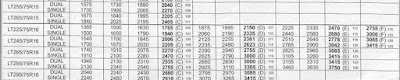
If you look at the published Load & Inflation tables you will see that some sizes are available in a number of different Load Ranges.

While these are LT tires they show both Inflation, Load Range and Load rating.



Here you can see that some sizes only come in one Load Range while others come in many. You will also note that a Load Range C, D, or E are only rated for the same number of pounds if the Inflation is the same.

One tire I designed was a Load Range E version of a Load Range D tire and after running all the required tests it was discovered that for this specific tire I only needed to change the number of strands of wire in the bead area (where the tire attaches to the wheel) to meet all the strength requirements. So you can see that it is impossible to make a broad statement on the tire construction to provide any useful information on the possible ride qualities of two different Load Range tires.

If you were to conduct a controlled ride test of 295/80r22.5 size tires with different Load Range but ran the same inflation level you would not be able to feel a difference in ride. However if you were to change the inflation level to achieve greater load capacity you might feel a difference but in that case wouldn't you expect a heavier loaded vehicle to have different "ride"? 

My original question in the title of this post is intenionally misleading as you will find that the load capacity of a "10 ply rated" tire and a Load Range E tire of the same size from the same drsign are really identical.

##RVT1045

Thursday, July 25, 2013

Tire Ride. What is important?

I was recently asked my opinion of Michelin tires for giving good ride. The person started with some statements to the effect that Michelin was the best manufacturer in the world and only recently had other tire companies managed to make tires that would keep their belts attached. 

This is my reply:
Not sure if I completely agree with some of your statements. I agree that Michelin will tell you that they are the best in the world but sometimes I think they say that in an effort to justify their price which many times seems to be the highest in the world.

Here is list of top 5  tire manufacturers in the world from 2012 based on sales.
Clearly the ability and technology to keep belts attached is tested severely in NASCAR (Goodyear), Indy CAR (Bridgestone/Firestone) and F1 (Pirelli 2011-2014, Bridgestone 1996-2010 ).
Does Michelin make good tires? Yes they do, but so do a number of other companies. Painting every size and type tire from any company with the same brush, is just as invalid as saying that since GM made the Vega, today's Cadillac is not so good or that since the Bugatti Veyron is the fastest car in the world they are the best in the world.
I think for large heavy duty tires with 100+ psi inflation, the sidewall is almost irrelevant for day to day ride comfort. I believe the tread area construction plays a much larger part in ride comfort than many believe.

I have heard from some Class-A owners that do use truck tires, and they say they have no problems with the ride of their tires. Having personally done ride evaluations on prototype GM, Ford, Mazda, Toyota, Fiat, and Honda cars and some trucks, for both short 2 to 8 mile evaluations as well as cross country 10 car multi week evaluations, I can tell you that tires are part of the equation but so are springs, shocks, suspension bushings, seat mounts and even wheel design.
 I once did a back to back comparison using the 4 same tires on the 4 same positions on a new Lincoln with the only a change being the style of the cast aluminum wheels and I could feel a ride harshness difference in the first mile of the evaluation. I was definitely surprised but was also convinced.
When people say "I changed from 5 year old abc tires to new cba tires the ride changed". I say why are you surprised? Your tread depth tripled among other changes, so of course the ride changed. You simply can not do a tire ride evaluation without comparing New abc tires to New cba tires on identical road under identical conditions. You certainly are not doing a valid comparison if you try and compare "long haul" tires from one company with "regional service" tires from another company. I bet than less than 10% of Class-A owners have bothered to compare tread depths when they compare tires. Most simply shop on price. Some on availability and others on company name but they seldom differentiate on type tire. They had good luck or bad luck with a tire from one company a number of years ago, so they paint all sizes and type tires from that company with the same advantages and disadvantages.
You might as well compare the ride of a Chevy Impala to a Cadillac STS (both made by GM) and ask why one is different from the other as to use the experience from someone in a Winibago 34' front gas to a Monaco 38' diesel pusher.  You need identical chassis, identical age, usage and  miles on the shocks and identical loading along with identical tread depth while driving on the same road to make a valid comparison. Oh yea, be sure you have the AC and radio off too as noise and ride comfort are related at certain frequencies.
Tires are not simple black round things. They are complex bag of compromises with ride, wear, noise, traction, fuel economy, handling, Ozone, heat resistance, and price being the interacting variables.