THANKS TO OUR SPONSOR!

THANKS TO OUR SPONSOR!
Your Ad here
Be sure to sign up for the weekly RV Travel Newsletter, published continuously every Saturday since 2001. NOTE By subscribing to RVTravel you will get info on the newest post on RV Tire Safety too
. Click here.
Huge RV parts & accessories store!
You have never seen so many RV parts and accessories in one place! And, Wow! Check out those low prices! Click to shop or browse!
Showing posts sorted by date for query why tires fail. Sort by relevance Show all posts

Sunday, October 12, 2025

Why do radial tires fail when overloaded or underinflated?

 I have a number of posts here on the topic of why tires fail. There are also more than 16 posts that mention "separation" or more accurately a "Detachment", as a reason or contributor to a tire failing. But maybe, some readers want more a scientific explanation.


This graphic is a computer-generated color depiction of the relative heat generated internally in a tire as it is driven down the road. Light blue is the coolest area, and red is the hottest.

When tires crack

I have covered the "artificial aging" of rubber in several posts. Basically, the molecular cross-link density increases, which can be thought of as stiffening and less flexibility. When rubber loses its flexibility, the molecular bonds crack. As more bonds crack, these cracks join up until they can be seen with the naked eye, as pointed out with the yellow arrows in the picture below.


 When tires develop these larger cracks, they simply grow over the next hundreds or thousands of miles, as seen in the next picture.

"Free-Spin Inspection"

Tires with these larger cracks can be identified by doing a "Free-Spin Inspection," as covered in detail in this post on how I inspect my tires.

When doing a "Free-Spin Inspection", If you discover the out-of-round or side-to-side movement as seen in the video in the above post, I strongly suggest you have the tire inspected by your tire dealer for that brand tire, or simply replace the tire if it is more than 3 years old.

By the way, the steel belts do not "slip". They are no longer attached as part of the structure of a radial tire.


I hope this helps understand the situation. 


Sunday, December 29, 2024

Do not do this to your RV tires


Do not bleed down your RV tire pressure because you think it will “explode” if you exceed the PSI number molded on the tire sidewall.

Almost every week I see posts on one or more of the various RV forums where people say they limit the PSI in their tires. Sometimes they say why, as in “to prevent a blowout.” Sometimes they do not say why, but their reasoning behind this practice is clear to me.

It appears that many people incorrectly believe that exceeding the “PSI” number molded on the tire sidewall is going to result in tire failure and explosion.

It may help to let people know about some of the testing that tires undergo during the development phase.

First some background

The “Max Inflation” statement on your tire sidewall really is the inflation associated with the Maximum Load capacity. If you actually read your tire sidewall, you will see that is what it says. So the number of PSI is really the minimum needed to support the stated load.

It is important to understand that we are always talking about the “cold” inflation and not the inflation of a tire that is running down the highway or has been in direct sunlight or driven on in the prior couple of hours. “Cold” inflation does not mean the tire needs to be refrigerated. It means the tire is at the prevailing ambient (surrounding) temperature.

Tire pressure monitoring systems

With the introduction of aftermarket tire pressure monitoring systems (TPMS) that report both tire pressure and the temperature of the sensor, people are now being exposed to information they have no previous experience with. They see tire pressure rising as they drive down the highway. Some may see a 10% to 20% rise in pressure from the pressure they set their tires to just a half-hour earlier. This increase is a cause for concern, not because they had any working knowledge of tire operating temperature or pressure, but simply because the pressure was higher than they expected.

What not to do

A few people have decided that they need to bleed down the high pressure because they thought the pressure number of the tire sidewall was the maximum it could tolerate. Of course, the action of bleeding down the hot pressure was exactly the wrong thing to do, as that meant that the tire would no longer be operating at the pressures expected by the tire engineer when they originally designed and tested the tire specification.

Obviously, this raises the question of how much pressure a tire can tolerate before the owner should be concerned. Well, I am going to give you some numbers, but these are only examples. I cannot speak for every tire company’s process or specifications. But if we start with a few guidelines, I think you can get comfortable and, hopefully, you will believe that tire design engineers do have a reasonable idea of what they are doing.

First off, we are only going to discuss regular production street tires that have passed DOT testing. The numbers I will use would basically be seen on new tires. I cannot advise on a tire’s capability after it has been damaged or run for tens of thousands of miles. Damaged tires can fail when reinflated, as seen in this video of a 22.5-size tire.

This video was made to show that welding on a wheel with a tire still mounted can result in a tire failure. Note the pressure at failure.


Tell service person if you drove on under-inflated tire

If your tire suffered a puncture and you drove any distance with the tire underinflated, you may have permanently damaged the body cords. That is why you should always tell the tire service person that you drove on the under-inflated tire so they know to use a cage or other restraining safety equipment. Age and miles can reduce the strength of any tire, but we do consider this degradation when approving a design.

Another consideration is the availability of high-pressure air. Most home compressors or those that supply air to hoses made available to consumers have an upper limit of about 150 PSI. Therefore, we don’t expect any consumer to have access to or to use industrial air pressure, which can be 400 PSI, or even special inflation units as used on aircraft tires.

Basically, many tires are tested to 300% to 400% of their rated inflation, or above 200 PSI, whichever is lower. I had a number of tires that could contain over 300 PSI when new. If they had been damaged, however, the same tire might fail at less than 200 PSI. But I also never, in my 40 years as a design engineer, saw a tire fail from normal pressure increase—and I was involved in the testing and evaluation of thousands of tires.

The bottom line

The bottom line is: Please do not bleed down your hot inflation pressure. You should ONLY set and adjust inflation when the tire is cool and at ambient temperature. Doing otherwise MAY result in you having a failure days or weeks later because you were running lower pressure than what was needed for the tire load you were applying.

Also, unless you have damaged your tire, it is unlikely to “explode” simply by adding 10% more cold air pressure.


Monday, September 2, 2024

Maximum Operational Tire Speed

 There are still a number of folks asking about tire operational speed and specifically with ST type tires. I hope this post will help.

Back in the 70's there was a National Motor Vehicle Speed limit of 55 MPH, and the RV market wasn't as big as it is today. Plus RV's were much smaller vehicles and many used Passenger Vehicle type tires.

Then the RV market started to grow and RVs became larger and heavier so tires offered on RVs needed to increase in capacity.

Based of info from someone in the tire industry at the time, we know that some RV companies did not want to use P type tires because of the loss of 10% of the load capacity and they did not wan to.pay for more expensive LT type tires so the RV companies asked for "Special Trailer" tires.

Not all tire companies agreed to the proposal and even today many companies do not make ST type tires.

The formula to calculate tire load was adjusted and included a statement on 65 MPH max speed. This showed up in the publish Industry standards as seen here.


 Goodyear even issues a Bulletin PSB #2011-13  in 2011 stating that "Industry standards dictate that tires with the ST designation are speed rated at 65 MPH (104 km/h) under normal inflation and load conditions."  Adjustments for higher speed up to 75 MPH would be allowed if there were either a decrease in Load capacity or increase in Inflation limit or both. The wording is convoluted but it specifies "Based on these industry standards, if tires with the ST designation are used at speeds between 66 and 75 mph (106 km/h and 121 km/h), it is necessary to increase the cold inflation pressure by 10 psi (69 kPa) above the recommended pressure for the rated maximum load.
- Increasing the inflation pressure by 10 psi (69 kPa) does not provide any additional load carrying capacity.
- Do not exceed the maximum pressure for the wheel.
- If the maximum pressure for the wheel prohibits the increase of air pressure, then the maximum speed must be restricted to 65 mph (104 km/h).
- The cold inflation pressure must not exceed 10 psi (69 kPa) beyond the inflation specified for the maximum load of the tire
."

Please note that the Goodyear bulletin does not completely match the publisher TRA guidelines.

In 2017 the US federal Trade Commission placed a tariff on all "non-speed rated" tires so the tire companies in Asia where the low cost ST tires were  made quickly adopted the use of a "Speed Symbol" based on the use of the SAE Passenger car Speed test to justify the use of higher speed rating.

This "Speed Test" only requires that brand new tires be capable of running 10 minutes at a stated speed so in reality the SAE test is just a high temperature resistance test. After running the test, tires are not subjected to any additional testing and are considered scrap.

Through all of this there has been no adjustment to the original load calculations that specified a 65 MPH Maximum operational speed.

We have all learned or read of the general degradation of tires in Trailer application with Interply Shear being a major physical cause for this degradation of the belt strength which can eventually lead to a "Belt Detachment"  AKA "Blowout".

So what does this all mean?  In my expert opinion:

1. ST type tires should not be run for any length of time above 65 MPH at the published Max Load for the given Load Range of the subject tire unless adjustments to load and inflation are made.

2. If you want to run your ST type tire at a speeds above 65 but no greater than 70 MPH you MUST increase the cold inflation by 10PSI. This inflation increase DOES NOT provide any increase in load capacity

3. If you want to run your ST type tires at speeds above 70 but not greater than 75 MPH you MUST increase the cold inflation pressure by 10 psi PLUS you must reduce the tire load MAX capacity by 10%

4. At no time should you ever increase the cold inflation pressure above the maximum PSI rating of the wheel as identified by the wheel manufacturer.

You should note that the Loads and inflations published in the Industry Standards book AKA TRA manual are based on a maximum operation speed of 65 MPH. The "Speed Symbol" is a sales and marketing tool and I find no information in the TRA manual that recognizes the SAE speed Symbol as superseding the existing TRA standards.

If or when such approval is issued by TRA I will adjust my statements above accordingly.

If you want to understand Interply Shear I suggest you review the following posts.

- https://www.rvtiresafety.net/2013/11/interply-shear-and-other-techno-babble.html

- https://www.rvtiresafety.net/2018/09/warning-super-technical-post-tire.html

- https://www.rvtiresafety.net/2018/07/question-on-radial-tire-belt-interply.html

- This link has a video showing the effects of tire cornering and the resultant Interply Shear

       https://www.rvtiresafety.net/2018/02/tire-inflation-not-same-for-all-trailers.html


I hope this clarifies the question of why ST tires in RV service seem to fail at a higher rate than regular Radials when used on cars and Light Trucks.


Wednesday, May 8, 2024

Why and how to take care of your tire valve cores


Tire valve cores are critical components to retain air in your tires.

Here are the components of a standard “snap-in” rubber valve. On the left is the rubber body of the valve stem. In the center is a standard valve core (I have a paper clip holding the valve open). On the right is the basic rubber valve cap.


Untold billions of these “snap-in” valves have been used for many decades in almost every passenger vehicle, light truck and RV trailer since the ’50s. They are cheap and usually work at holding the air in the tire. Normally, they were replaced whenever a new set of tires was applied to the vehicle, so the life span of this type of valve was only a few years.

Parts of the valve core

One feature of the valve core is visible in the above picture. The air is let in or out when the center pin is depressed and the “valve” portion, where the paper-clip is, is opened. The small red sieve is the gasket that sealed the valve core in the body of the stem. The valve core can leak, as seen in the below picture.


I read the questions in a number of RV forums, on what valve stem to use with an external TPMS sensor. This post will cover the “bolt-in” metal valve stem.

This picture shows two problems with cheap “snap-in” rubber stems. One problem is its flexibility, and the other is the fact that rubber gets old and can crack, which can lead to a leak. A standard 65 psi max “snap-in” rubber valve stem is very flexible. The weight of a tire pressure monitoring system (TPMS) sensor can cause vibration of the rubber stem and potentially a stem failure.


The addition of an external TPMS sensor can, in some cases, accelerate the cracking due to the extra weight out on the end of the stem.

Here is a rubber stem with a TPMS sensor. You can see the mark left on the wheel from the rubber stem bending.


Some people think the 80 psi max “high pressure” HP-600 rubber valve stem is OK to use with external TPMS sensors, but you can see the HP-600 is also flexible.

Rubber stem can fail with TPMS installed

Here is proof that an HP rubber stem can fail when a TPMS sensor is installed.

Leasking HP stem  video


This valve stem failure resulted in a tire failure.

In my opinion, staying with any “snap-in” type rubber stem is false economy, given the metal bolt-in stems only cost $3 to $5 each. Not all tire stores will have the bolt-in metal valve stems in stock, so check first. If they don’t have them, you can get bolt-in stems at AutoZone, O’Reilly’s, Advance Auto Parts, NAPA, or most any auto parts store or even on Amazon.

They are easy to install, too. Don’t let the service center tell you installing metal stems is a lot of work.  Watch and you will see.   HERE


Rubber snap-in stems

On standard “rubber snap-in” stems, like the TR413, if you look down the hole you can see the end of the brass part of the stem.


 These have been used for decades on hundreds of millions of tires. These can be installed by hand using a “puller” that stretches the rubber. That makes the diameter of the stem small enough to “snap” into place in the wheel hole. The “puller” in the picture is the tool with multiple notches that allows leverage to be used to generate the force to “pull” the rubber stem into the hole in the wheel.


 Once installed, the wheel “pinches” the rubber part of the stem to seal the air in. 

High pressure stems

Next, we have the “high pressure” stems, such as the HP-500.


The Diameter shown in the picture is for the the standard hole of 0.453" This is an industry standard so don't try to find some at 0.500". 


Bolt-in stem

Now, when we look at a “bolt-in” stem, like this TR416s, we see the location in the wheel hole at the arrows. We can also see the much larger brass body (nickel-plated in this piece) that goes inside the air chamber and expands to a broad base. This type of stem needs to be installed through the wheel hole with the rubber grommet sealing the air. An external washer is used and the nut is to be tightened to specification to prevent air loss.

Here is the metal part of the bolt-in stem without the rubber gasket. The arrows point to where the wheel would end up.


Here are a couple pages from the U.S. Tire & Rim Association yearbook, aka TRA, which publishes the “interchange and fitment” specs so all tire companies and valve manufacturers know what dimensions are required. This is the book where all the Load & Inflation tables come from and might be considered the Tire Engineer’s “Bible”. It is used by tire engineers around the world when they are making tires that are intended to be used in the U.S.

Here are the dimensional specifications used by valve manufacturers and some details on the smallest but potentially the most critical part on your RV, the valve core, that we covered previously.


They even include something as relatively insignificant as the height of the little pin that sticks out of the valve stem.


As you can see, there is a lot of engineering work involved in the valve stem system. If the proper stem is installed correctly, the system should operate with no problems for many tens of thousands of miles. But as with any system, if incorrect parts or improper method (torque) is used, you may have problems.

Wednesday, February 21, 2024

Why do tires fail? Tire expert has the answers

 As an actual Tire Design and Quality Engineer, I know from my 50 years of tire experience, including 25 with a primary focus on failed tire forensic inspection, that tires fail from two basic causes:

  • Low air pressure, and/or
  • Long-term degradation of the rubber, usually from excess heat.

Low air pressure

An active leak from a puncture or loose valve stem or valve core is the most common reason. Also, poor or no inflation maintenance contributes to low air pressure as all tires lose pressure at about 1% to 2% a month, excluding the pressure change due to changes in ambient temperature, and can lead to a sidewall flex failure, more commonly called a “blowout”.

The sidewall cord can melt (polyester) or fatigue (steel). Many travel trailer and fifth wheel owners fail to realize that they will never “feel” the results of a tire losing air until it is too late. Then they are surprised when the sidewall “lets go.” The rapid air loss “bang,” even when the tire only has about 10 to 20 psi in it, is a big surprise IF they even hear it. A tire pressure monitoring system (TPMS) can provide warning of air loss, so it is good insurance. A TPMS can easily pay for itself many times over.

Long-term degradation of rubber

The long-term degradation of the rubber at the edges of the belts in radial tires can lead to a belt and/or tread separation. Even if the tire keeps its air, you can have this type of failure, so a TPMS will not provide a warning in this case.

This degradation comes with age, as the rubber is always losing flexibility. Just think of those rubber bands you found in the back of the old desk drawer. Even in cool and dark they got brittle. However, running at, near or above the load capacity of a tire will result in increased heat generation. Increased heat actually can accelerate the aging process with a doubling of the rate with each increase of 18 F. Running a margin of at least 15% between tire capacity and measured load is a good first step. Running at higher speed will also generate excess heat. For ST-type tires, this means faster than 65 mph, no matter the Max speed rating.

Realizing that more than half of the RVs on the road have one or more tires in overload is one main contributor to the high tire failure rate. Simply thinking that a tire will fail because the tire plant building is painted blue rather than green is not logical. But many still have feelings along those lines when it comes to where a tire is made.

Buying the lowest cost “no-name” tires is, IMO, a major contributor to poor results. If the main objective is the lowest cost tire, why would anyone be surprised with short tire life?
Just paying more, however, is no guarantee of better quality. I believe the best tire shopping tool available is comparing warranty and service support.

Can you get a multi-year warranty on the tires? Is it possible to get road hazard coverage? Is there a nationwide network of dealers who stock the brand you are considering? The answer to these questions may provide a better indication of tire quality than the opinion of other RV owners published on the internet.

There are some self-appointed “experts” out there who think that selling tires for a numbers of years qualifies them to make technical pronouncements on tire technology. I would suggest that people review "The Pneumatic Tire"   published by the US DOT before making a claim of being a “Tire Expert”.


Sunday, October 15, 2023

Why you should not spin your tires. A forensic analysis

 I have mentioned a few times that toward the end of my career as a Tire design Engineer I became a specialist in failed tire inspection. In my RV tire seminars I have likened this work to what was shown in the TV series CSI.

I will be sharing the results of  a few of my inspections over the next few weeks and months but will start off with one of the more exciting types of tire failure. I was not involved with the tire seen in this video but it provides the evidence on why it is recommended that if your car or truck is stuck in mud or on ice you should not spin your tires. The video is just entertainment.


I believe this truck was part of some entertainment at some auto event but it shows what can happen when you exceed the speed capabilities of a tire. The wire in the tire bead that holds the tire on the wheel can fail at excessive speed.

Here are some pictures of a tire I did receive as part of my job.

This is what the tire looked like when I received it.


As you can see it looks

like the tire was "shattered".

This is very unusual as

normally tires fail from either 

a sidewall failure from being run low on air, or have a belt detachment due to long term overloading and excessive heat.

This picture shows the broken steel of the belts and does not show signs of a detachment between the belts.


When steel fails from tension the steel shows a narrowing of the filaments as easily seen in this shot of the tire bead wire. This is classical "Cup - Cone" tensile failure of steel


Here is what the bead wire looked like.


A close (microscopic) examination of the steel filaments shows the signature "Cup-Cone" shape as seen in this Electron Microscope comparison of tensile failure vs a cut filament as seen in the lower right.


This is one of the PowerPoint slides I use in my RV Tire seminars.


So the bottom line is that if you are stuck on mud or ice and your car or truck does not have "limited-Slip" differential if one tire stops and the other spins the spinning tire can easily exceed the high speed capability of the tire.

So do not "spin" your tire in an effort to get moving. I would also recommend against showing off at car shows.

Monday, March 6, 2023

'Defective’ tires: Just what is the ‘defect’?

 I have heard people claim they had a “defective” tire when they post about a tire failure. I have even addressed claims from lawyers and supposed “experts” that a group or even thousands of tires had “a defect” that caused tires to fail. However, for some reason, they can almost never point to or identify the specific component or material that contained said “defect”.

I spent the majority of my 40+ years as a tire design engineer looking at and investigating tire failures. I can say that I have identified a few tires that contained a “defect.” But before I continue we need to be sure we have a common understanding of the word “defect” and what we mean when we use it.

Definition of “defect”

Merriam-Webster says the meaning of “defect” is “an imperfection or abnormality that impairs quality, function, or utility: shortcoming, flaw.” I note that they are not saying that an item has a defect if it has failed to perform. They are talking about a specific “imperfection or abnormality” in an item.


I sometimes offer the following in an effort to clarify the concept. If we discover a dead body, should we always assume that the person was murdered? Of course not. But jumping to a conclusion about the most extreme cause seems to be what some want to do while ignoring the need for a thoughtful and reasoned collection of facts and evidence.

Tires can fail for dozens, if not hundreds, of different contributing factors, but most do not involve design or manufacturing mistakes. When I read a post on an RV forum or receive an email about a “failed” tire, I do not start with the assumption that there was a manufacturing or design mistake. I do start with a close examination of the tire, wheel, and valve, as many times the evidence is in front of our faces. The question is, are we willing to take the time and make the effort to look for the evidence that is almost always there?

Why people might use the word “defect”

I believe that many times some people use the word “defect” as they do not have the knowledge of how to do even a basic inspection. That is understandable. But if we want to avoid a repeat, wouldn’t it be best to learn the real reason for the failure and take steps to try and prevent a re-occurrence? What bothers me, though, is when I hear lawyers or reporters use the word possibly to grab the attention of those reading an article. I believe that a headline saying “Another RV tire failed, facts to follow” would not gain much readership.

In my posts on RVTravel.com and in my RV Tire Safety blog,  I have provided numerous examples of failed tires that were initially claimed to be “defective” such as the following examples.

A tire that was run with low inflation.

One that has an external cut.

Or this tire with a plug in the sidewall.

Or this tire failure below that was due to leaking air. This failure even ended up on YouTube, but the video did not mention the evidence of the tire having been run with very low air pressure.

Currently, there are news articles mentioning failures that occurred many years ago on some RV tires that might have been improperly installed on some heavy RVs. While I have no details, I do recall reading the word “defective” in the article, but no mention of what the “defect” might have been.

Did a “defect” really cause the tire failure?

I would suggest that when you read a “news” article about tire failures and find the word “defective,” you stop and see if the author mentions what the imperfection or abnormality was in the tire that caused the failure.

Friday, August 26, 2022

Can you do a tire "Autopsy" at home?

 When you have a tire failure many people are only interested in replacing the tire as soon as possible. But there are others that want to understand the "why?" of the failure so they can take the steps necessary to avoid a re-occurrence of the problem for if you don't know the real basic reason for the failure any corrective action you might take may not actually "fix" the problem.

Think of a car not starting. If you jump to the conclusion that the reason for the non-start, is a bad battery when it really is the first signs of a failure of the starter motor or a failure of the ignition switch, the new battery will not "fix" the no start problem will it?

Now I am not saying that everyone needs to have the tools and skill to do the "autopsy" shown below but when I was working as a Forensic Tire Engineer I was expected to dig deep and to learn the real reason for a tire to fail. 

It is in my basic nature to be inquisitive, so when I was contacted by an RV owner who had what he thought was a tire about to fail I decided that I could help him learn and understand the "why" when he started asking questions as many engineers do.

The following is what we did and what we learned.

As you can see the tread is very round.


This is not normal for a steel belted radial tire.


John, the owner measured the OC of all 4 tires and found a big difference with one tire being an inch larger than the others.


Clearly something was different this tire.


After removing the tire from the rv and looking closely at the tire he noticed that one portion of the tread seemed to "bulge" outward.


His next step was to confirm the tire was no longer round.


 After de-mounting the tire and inspecting the interior he said he could not find any indication of failure. At that point John contacted me and after some back and forth I told him how to dissect the tire so he could ship the tread portion to me for a more detailed inspection.

You can see the work he had to do to get the tire tread area cut from the rest of the tire.


This was John's effort to

find the belt separation,

but he was not sucessful.

When I received the tread my experienced eye quickly found the location of the belt separation.

This level of effort on John's part was extraordinary but we got the evidence to prove a belt separation as the reason for the bulge in the tread area.

Now you don't need to go to all this effort as a simple "Free Spin" inspection as seen in this YouTube video will provide the evidence you would need to decide if it is time to replace your tires.

I have recommended that owners of RV trailers do a "Free Spin" inspection once a year or every 2,000 miles. This schedule might line up with when you inspect brakes or re-pack the wheel bearings so the Free Spin is not any additional effort and if you discover a wobble or bulge in your tire you know that it's probably time to replace it rather than wait for it to come apart on the side of the Interstate. 


Friday, July 15, 2022

You just had a tire failure. Did you take apropriate action to prevent a re-occurance?

If someone has a problem with a tire it would help us all if some effort was made to learn the real root cause. If the root cause is a manufacturing problem then it should be reported to NHTSA and if enough complaints are received there is the possibility of a recall. The threat and costs associated with recalls can be enough incentive for a MFG to change and improve the durability of their tires. It is also possible that external conditions such as  road impacts caused the failure. Another possibility is a combination of overload and under-inflation. Tires like any other product do have a limit in their ability to tolerate loads greater than their design limit. One thing about tires, unlike items made of metal such as a length of chain, is that tires can tolerate overload for a short time but eventually they will fail and the structural damage is cumulative. Metal items like a piece of chain also have a rated load and as long as you never exceed that load the chain retains it's strength.
 
If you have a failure it is sometimes possible to do an inspection and to learn the reason for the failure. However a detailed inspection requires a close inspection by a trained and knowledgeable specialist. If you had a tire fail and it looked like this tire,
 
 
do you think you could identify the evidence of the reason for the failure? The multiple pictures of this tire (well lit and in focus) provided the physical evidence to allow the root cause of the failure to be identified with a high level of probability as the act of checking tire inflation about 50 miles earlier in the day. This is an example of why it is important to get a number of pictures of the failed tire and to have the tire inspected by a knowledgeable Tire Adjustment Engineer. Each of the major tire companies have a team of experienced tire engineers available to inspect tires that have been presented to a tire dealership run by the tire manufacturer, for an "adjustment" and a request for compensation for the failure.

If you have ever had a tire failure did you just dispose of it as soon as possible and just claim it failed because of the zip code where the tire was made, or did you make a real effort to learn the real cause of the failure so you could take appropriate action to improve your chances of avoiding a repeat?

Just so you know I have identified three different and distinct locations of different evidence of the cause and reasons for this tire failure. All of these have been identified in one or more of my blog posts. Here is one, if you are interested.

##RVT1061

Friday, May 13, 2022

What is the Root Cause of a tire failure?

 "Root Cause" is the initiating condition or first cause. Someone having a temperature is not a Root Cause or Proof of an infection but is an indicator that there is probably an infection of some sort. A "Blowout" is not considered the Root Cause of a tire failure just the final condition.

In reality, tires fail for a relatively small number of Root Cause reasons that can be discovered, but it does require detailed and sometimes exhaustive investigation. By "Root Cause," I mean the initiating feature or condition that eventually led to the failure. Too often people confuse the tire's ending condition with the initiating or "Root Cause" reason for the tire to end up in the condition they are observing.
For the last few years of my 40-year career as a tire engineer, my primary job duty was to investigate failed tires that had conditions that were hard to understand or provided confusing and sometimes contradictory evidence as to the Root Cause for their condition. With that background, I have developed some guiding principles for the most likely reasons for tires to fail.
These are, in no special order:
1. External Damage. These include punctures, cuts, impacts, wheel and valve failures, and similar conditions.
2. Run Low Flex Failure. This is best described by the failure of the tire sidewall due to excessive flexing. The flexing is the result of operation when the tire is significantly under-inflated.
3. Belt & Tread Separations. This is when the belts of a radial tire detach from the body or from each other and/or when the tread rubber detaches from the top belt.
4. Manufacturing Defect. For the purpose of this discussion, this would be when components of a tire were not manufactured to the intended specification.
The "Why" for some of these are obvious, such as the External Damage category.
Others can be further traced to various contributory reasons.
Run Low Flex Failure This is a more accurate description of what some incorrectly call "Blowout". When a tire loses significant inflation air they flex much more than the body cord can tolerate. Excess heat is generated which can, in extreme cases, result in the Polyester actually melting. I showed examples of what this can look like link in THIS post. Polyester is used in most Passenger, ST type, and LT type tires. Steel body tires are used on most Class-A RVs, the steel can fatigue. I covered "Zipper" failures and steel fatigue in THIS post.
Belt & Tread Separations occur primarily because the rubber around the belt cords or between the belt rubber and the tread rubber isn't strong enough. Now it can be weak for a variety of reasons. Some might be design, some might be manufacturing and some weakening can be caused by cumulative improper service conditions.
Now let's talk about tires made by a reputable company, i.e., one that has tire stores and dealers with physical stores and sells tires that have a warranty of two or more years.
If this tire is subjected to thousands of miles of lower inflation or higher loading or operation at higher speeds or stored is full sunlight it is reasonable to expect the strength of the belt & tread area rubber to lose a good portion of its strength primarily due to the increased operating temperature of the tire. If this tire is in service on a tandem axle trailer then there is also increased Interply Shear which can overload the belt area rubber. The combination of the above may result in a belt or tread separation.
Another possibility is a Manufacturing Defect. These usually occur in small numbers as tires are built in batches so the substitution of the wrong type of rubber may cause tires to fail. It is important to understand that in almost all cases this type of "defect" usually shows up in the early life of the tire. It is also very important to understand that, unlike some lawyers, engineers deal in facts and logic. Simply having a tire fail is not in itself proof of a defect but all to often that is the position that those in the legal profession seem to jump to. That approach may result in a nice payout to the lawyer but will not result in product improvement as there has been no determination or identification of the actual initiating "defect".
Finally, there is the possibility of a design weakness. Now I do not believe that anyone is intentionally designing tires to fail but this sometimes may occur when the performance goals of the manufacturer are limited to meet the bare minimum for strength and durability and the focus is primarily on low cost. There is no absolute way to identify these tires but I do believe there are indicators when looking for tires that are made to a higher standard of quality and durability.
I would consider a tire company reputable if it had a chain of stores across the country. If the tires carry the name of the manufacturer and have a multi-year warranty the longer the better then they probably have higher durability requirements than those established by DOT.
For ST type tires I would look for tires with a Speed Symbol of "L" (75 mph) or faster. Now a side point about speed. I did a POST a little while ago on the topic and strongly recommend you read it. I do not think I would recommend any tire for general use that does not have a speed rating molded on the sidewall. Few realize that ST tire load formula is based on a 65 MPH max operation speed.
I do hope this post will help some to have a better understanding of what can contribute to tire failure and consider what you can do to lower the chances of having such a failure.
 
Over the next few weeks I will be posting pictures of tires with different conditions and I will identify what was discovered with a detailed inspection and identified as the most likely Root Cause.  Just to whet your appetite here is a video showing at time 1:12 a 
tire that was initially suspected of having some "Defect".  The physical evidence that proves what the Root Cause was can be seen in the video if you look closely and understand what you are seeing.  If you think you know the answer post it in the comments and the first 5 people to get the answer right with get their name published in my next post. Along with bragging rights.

##RVT1052
 

Friday, May 6, 2022

Tire "Failed for no Apparent reason" I think not.

OK, as you know I follow a number of RV forums. Here is one that caught my eye. Maybe some can learn this lesson before they end up in big trouble.


The post started off with   "Well, I can assure that a tire can blow up for no apparent reason. LT275/70R18 Americus Commercial date code 3518. Truck was shaking a bit. Thought drive shaft. If any of you ever drove a bit heavy truck (I used to drive fire trucks) that sat for a long time and got a flat spot, well drive shaft or flat spot feeling.

Couldn't see anything wrong but decided to take my clunker over to (a local NAPA store) and let them have a look. Its about 15 miles. Missus following. Truck was shaking even worse. Missus said she saw the left front "flapping" (her words) and I queried why she didn't call me so I could pull over and check. Anyway I went to the tire and checked by feeling the inside and there was a definite bulge. So I decided to let that go and went in to the office and BANG! rubber off the inside of the driver side front blew off; about a foot long x 8 inch hunk. Tire still holds air. Always kept those tires aired properly.

Bought four Cooper Discoverer A/T All-Season LT275/70R18 125S Tires. The old Americus tires no longer had my confidence. I praised the Lord I was able to make it over to the NAPA without a blow out on the road.

Michelin's would have been my choice but they are outside what I wanted to spend. I checked Sams Club and the same tires were about $100 more a piece than the Coopers.
"


I wrote the following: I hope this truck owner and some that are reading this post can gain some knowledge.

Well there clearly was a reason for the failure as tires are not Magic. I do not understand what was meant by "blow up for no apparent reason"  If the owner is saying  that he did not understand the different technical reasons for a tire to fail, I can understand that, but as a minimum people should read and try and understand the information in THIS post as it covers the two main reasons for a tire to fail. I have posted this "Why tires Fail" on at least a dozen different RV forums, but as they say you can lead a horse to water but you can't make them drink.
 
When a tire fails, I strongly suggest that you should make at least a minimal effort to understand the "Why" otherwise the actions you take may not prevent another failure.

Think about getting in a car or truck and turning the key and the vehicle doesn't start. Would you simply replace the battery without confirming the reason it didn't start was because the battery didn't have enough charge? What if you were out of gas? Would replacing the starter motor "fix that problem? Of course not. You may not have thought about it but you already approach "Problem Solving" in a logical manner.
 
Tire failures should be approached in the same way if you want to avoid making the same mistake over and over

The vibration you felt was a significant hint that the tire was in the process of coming apart. Tires simply do not go from having a 100% solid construction to having the components such as the steel belts separate the next instant. 

Here is a more detailed post on why tires might fail.    

Here is a story of a tire inspection I did on a tire that was in the process of coming apart.
 As you can see there were a number of warning symptoms. Some were similar to the symptoms you experienced but failed to understand or act upon. 
 
Luckily you were not driving your truck with a significant load at speed when the front tire finally came apart. That could have been serious. I believe that a little self education can be a significant help in reducing potentially serious problems if you have a tire failure.

##RVT1051

Friday, April 29, 2022

Is the temperature reading of your TPMS correct? Probably Yes, BUT...

 IMO TPMS are of little value when it comes to temperature warning for tires. Same for IR guns.

I have written a number of times on TPMS Temperature reading really being a reading of the metal wheel and not the rubber tire as metal conducts heat while rubber is an excellent insulator. So your TPMS can be used to provide warning of potential problems with wheel bearings, breaks and other metal mechanical parts.

These posts use data from my ongoing, direct comparison of internal vs external sensor TPMS. My data suggests that there is no meaningful difference in pressure reading based on the test of 12 sensors.
When seeing people claim the TPMS temperature reading were useful for predicting impending tire failure, the engineering DNA in me kicked in and I devised a plan to test 12 sensors. These come from two different companies. One set of 6 external sensors is from TireTraker and one set of 6 internal sensors is from TechnoRV who provided the internal TST  system. My thanks to both companies for their support in my efforts to help educate the RV community about tires.

The question is: How do I make the test both fair and useful? For the pressure test, I decided to eliminate as many variables as possible and get all 12 readings from the same air chamber at the same time and compare them all against my personal digital hand gauge that I have checked against an ISO certified laboratory gauge.
Note: my hand gauge reads to 0.5 psi which is way more precise than anyone needs for checking tires in normal highway use.

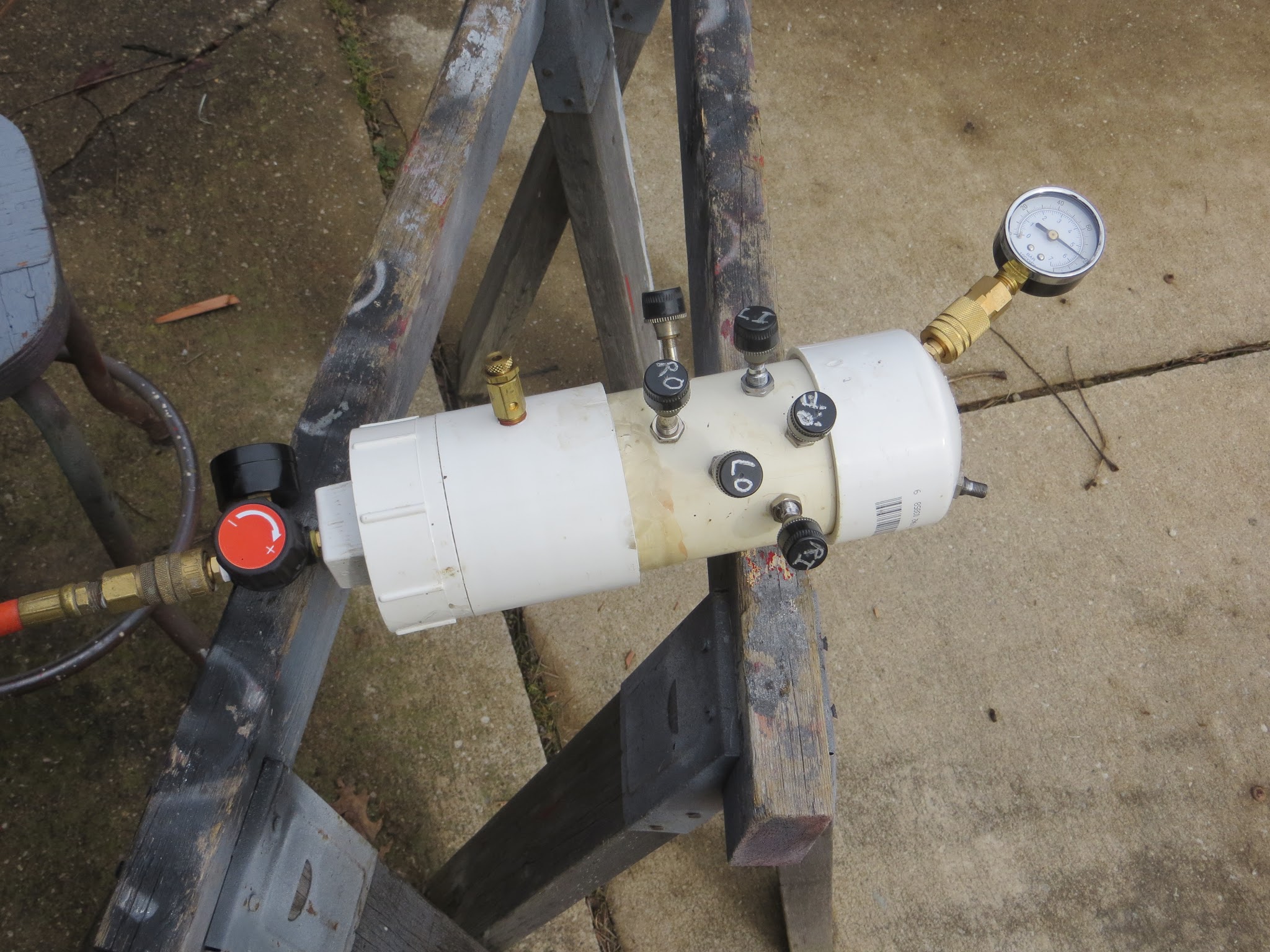
Here is the test fixture I made.
6 Internal sensors are inside the tube and 6 external sensors are on the outside along with a pressure regulator, a safety pop-off, and a reference dial gauge that allowed a visual check plus the test port for my hand held digital gauge that I have confirmed accurate to +/- 0.5 psi against an ISO Certified master gauge.

Here are the results of my comparison test. The target pressure is 80.0 psi as reported by my handheld digital gauge.

Set A  1 reading of 78 psi,  5 readings of 79 psi
Set B  2 readings of 78, 2 readings of 79 and 2 readings of 80 psi

I also recorded the temperature.
Set A  4 readings of 66 F, one each of 64 and 68F
Set B  4 readings of 69 F  and 2 readings of 68

I have recorded the internal vs external pressure difference in reported running pressure with the following results.


I do not consider any of the differences in the readings of the internal vs external sensors pressure to be significant or meaningful for a TPMS, remembering that at Ambient I observed 3 to 5 psi differences when all 12 sensors were measuring an identical pressure, which is not too far off the claimed accuracy for TPMS.
 
BUT

The problem with TPMS temperature readings is that they are not able to read the hot spot of a tire. Here is a graphic representation to tire temperature differences.


Since heat can kill a tire, and tires simply do not fail based on their average temperature but they can fail if a single spot exceeds the ability of the rubber to maintain its strength. With this large temperature spread and the fact that the hottest spot in a radial tire is about 3/8" to 1/2" away from the air chamber and the internal TPM sensor is reading the average air temperature in the air chamber, I would ask why anyone would believe that a TPMS "High Temperature" reading is a reliable method of warning of an impending tire failure.

I started this post by saying I did not think that TPMS or IR guns were reliable tools for predicting an impending tire failure based on the reported temperature.  I will cover IR guns next week.

=================
##RVT1050