THANKS TO OUR SPONSOR!

THANKS TO OUR SPONSOR!
Your Ad here
Be sure to sign up for the weekly RV Travel Newsletter, published continuously every Saturday since 2001. NOTE By subscribing to RVTravel you will get info on the newest post on RV Tire Safety too
. Click here.
Huge RV parts & accessories store!
You have never seen so many RV parts and accessories in one place! And, Wow! Check out those low prices! Click to shop or browse!

Friday, April 29, 2022

Is the temperature reading of your TPMS correct? Probably Yes, BUT...

 IMO TPMS are of little value when it comes to temperature warning for tires. Same for IR guns.

I have written a number of times on TPMS Temperature reading really being a reading of the metal wheel and not the rubber tire as metal conducts heat while rubber is an excellent insulator. So your TPMS can be used to provide warning of potential problems with wheel bearings, breaks and other metal mechanical parts.

These posts use data from my ongoing, direct comparison of internal vs external sensor TPMS. My data suggests that there is no meaningful difference in pressure reading based on the test of 12 sensors.
When seeing people claim the TPMS temperature reading were useful for predicting impending tire failure, the engineering DNA in me kicked in and I devised a plan to test 12 sensors. These come from two different companies. One set of 6 external sensors is from TireTraker and one set of 6 internal sensors is from TechnoRV who provided the internal TST  system. My thanks to both companies for their support in my efforts to help educate the RV community about tires.

The question is: How do I make the test both fair and useful? For the pressure test, I decided to eliminate as many variables as possible and get all 12 readings from the same air chamber at the same time and compare them all against my personal digital hand gauge that I have checked against an ISO certified laboratory gauge.
Note: my hand gauge reads to 0.5 psi which is way more precise than anyone needs for checking tires in normal highway use.

Here is the test fixture I made.
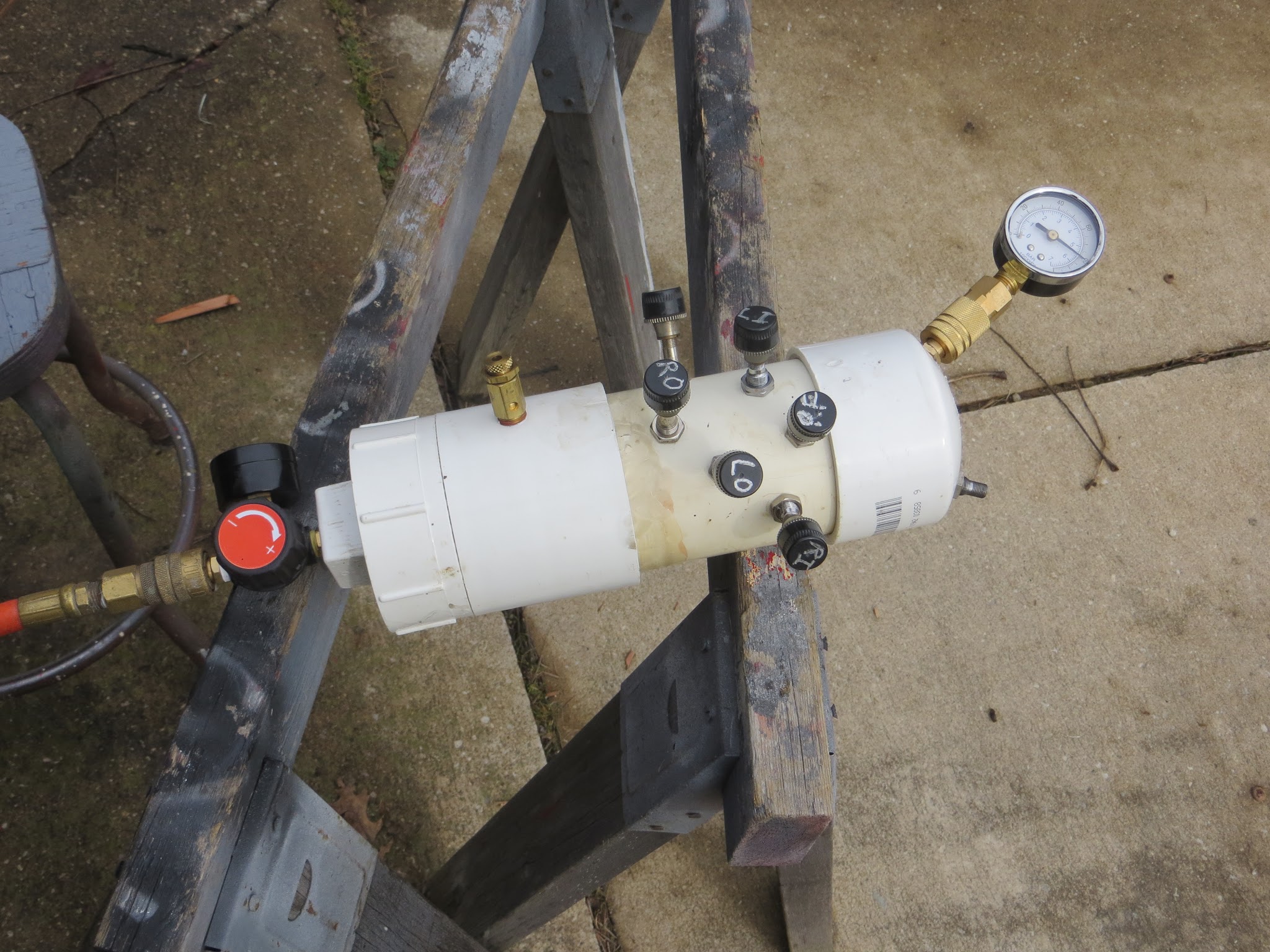
6 Internal sensors are inside the tube and 6 external sensors are on the outside along with a pressure regulator, a safety pop-off, and a reference dial gauge that allowed a visual check plus the test port for my hand held digital gauge that I have confirmed accurate to +/- 0.5 psi against an ISO Certified master gauge.

Here are the results of my comparison test. The target pressure is 80.0 psi as reported by my handheld digital gauge.

Set A  1 reading of 78 psi,  5 readings of 79 psi
Set B  2 readings of 78, 2 readings of 79 and 2 readings of 80 psi

I also recorded the temperature.
Set A  4 readings of 66 F, one each of 64 and 68F
Set B  4 readings of 69 F  and 2 readings of 68

I have recorded the internal vs external pressure difference in reported running pressure with the following results.


I do not consider any of the differences in the readings of the internal vs external sensors pressure to be significant or meaningful for a TPMS, remembering that at Ambient I observed 3 to 5 psi differences when all 12 sensors were measuring an identical pressure, which is not too far off the claimed accuracy for TPMS.
 
BUT

The problem with TPMS temperature readings is that they are not able to read the hot spot of a tire. Here is a graphic representation to tire temperature differences.


Since heat can kill a tire, and tires simply do not fail based on their average temperature but they can fail if a single spot exceeds the ability of the rubber to maintain its strength. With this large temperature spread and the fact that the hottest spot in a radial tire is about 3/8" to 1/2" away from the air chamber and the internal TPM sensor is reading the average air temperature in the air chamber, I would ask why anyone would believe that a TPMS "High Temperature" reading is a reliable method of warning of an impending tire failure.

I started this post by saying I did not think that TPMS or IR guns were reliable tools for predicting an impending tire failure based on the reported temperature.  I will cover IR guns next week.

=================
##RVT1050

Friday, April 22, 2022

Simple question: Why do tires fail?

In reality, tires fail for a relatively small number of Root Cause reasons that can be discovered, but it does require detailed and sometimes exhaustive investigation. By "Root Cause," I mean the initiating feature or condition that eventually led to the failure. Too often people confuse the tire's ending condition with the initiating or "Root Cause" reason for the tire to end up in the condition they are observing.

For the last few years of my 40-year career as a tire engineer, my primary job duty was to investigate failed tires that had conditions that were hard to understand or provided confusing and sometimes contradictory evidence as to the Root Cause for their condition. With that background, I have developed some guiding principles for the most likely reasons for tires to fail.

These are, in no special order:
1. External Damage. These include punctures, cuts, impacts, wheel and valve failures and similar conditions.
2. Run Low Flex Failure. This is best described by the failure of the tire sidewall due to excessive flexing. The flexing is the result of operation when the tire is significantly under-inflated.
3. Belt & Tread Separations. This is when the belts of a radial tire detach from the body or from each other and/or when the tread rubber detaches from the top belt.
4. Manufacturing Defect. For the purpose of this discussion this would be when components of a tire were not manufactured to intended specification.

The "Why" for some of these are obvious, such as the External Damage category.
Others can be further traced to various contributory reasons.

Run Low Flex Failure This is a more accurate description of what some incorrectly call "Blowout". When a tire looses significant inflation air they flex much more that the body cord can tolerate. Excess heat is generated which can, in extreme cases, result in the Polyester actually melting. I showed examples of what this can look link in THIS post. Polyester is used in most Passenger, ST type and LT type tires. Steel body tires are used on most Class-A RVs, the steel can fatigue. I covered "Zipper" failures and steel fatigue in THIS post.

Belt & Tread Separations occur primarily because the rubber around the belt cords or between the belt rubber and the tread rubber isn't strong enough. Now it can be weak for a variety of reasons. Some might be design, some might be manufacturing and some weakening can be caused by cumulative improper service conditions.

Now let's talk about tires made by a reputable company, i.e., one that has tire stores and dealers with physical stores and sells tires that have a warranty of two or more years.
If this tire is subjected to thousands of miles of lower inflation or higher loading or operation at higher speeds or stored is full sunlight it is reasonable to expect the strength of the belt & tread area rubber to loose a good portion of its strength primarily due to the increased operating temperature of the tire. If this tire is in service on a tandem axle trailer then there is also increased Interply Shear which can overload the belt area rubber. The combination of the above may result in a belt or tread separation.

Another possibility is a Manufacturing Defect. These usually occur in small numbers as tires are built in batches so the substitution of the wrong type of rubber may cause tires to fail. It is important to understand that in almost all cases this type of "defect" usually shows up at early life of the tire. It is also very important to understand that unlike some lawyers, engineers deal in facts and logic. Simply having a tire fail is not in it self proof of a defect but all to often that is the position that those in the legal profession seem to jump to. That approach may result in a nice payout to the lawyer but will not result in product improvement as there has been no determination or identification of the actual initiating "defect".

Finally there is the possibility of a design weakness. Now I do not believe that anyone is intentionally designing tires to fail but this sometimes may occur when the performance goals of the manufacturer are limited to meet the bare minimum for strength and durability and the focus is primarily on low cost. There is no absolute way to identify these tires but I do believe there are indicators when looking for tires that are made to a higher standard of quality and durability.
I would consider a tire company reputable if it had a chain of stores across the country. If the tires carry the name of the manufacturer and have a multi-year warranty the longer the better then they probably have higher durability requirements than those established by DOT.

 For ST type tires I would look for tires with a Speed Symbol of "L" (75 mph) or SLOWER. Now a side point about speed. I did a POST some time focusing on speed and strongly recommend you read it. I do not think I would recommend any tire for general use that does not have a speed rating molded on the sidewall. Few people realize that ST tire loading is based on the assumption of 65 mph Max operation speed

I do hope this post will help some to have a better understanding of what can contribute to tire failure and consider what you can do to lower the chances of having such a failure. 


##RVT1049