THANKS TO OUR SPONSOR!

THANKS TO OUR SPONSOR!
Your Ad here
Be sure to sign up for the weekly RV Travel Newsletter, published continuously every Saturday since 2001. NOTE By subscribing to RVTravel you will get info on the newest post on RV Tire Safety too
. Click here.
Huge RV parts & accessories store!
You have never seen so many RV parts and accessories in one place! And, Wow! Check out those low prices! Click to shop or browse!
Showing posts with label Belt Separation. Show all posts

Sunday, October 12, 2025

Why do radial tires fail when overloaded or underinflated?

 I have a number of posts here on the topic of why tires fail. There are also more than 16 posts that mention "separation" or more accurately a "Detachment", as a reason or contributor to a tire failing. But maybe, some readers want more a scientific explanation.


This graphic is a computer-generated color depiction of the relative heat generated internally in a tire as it is driven down the road. Light blue is the coolest area, and red is the hottest.

When tires crack

I have covered the "artificial aging" of rubber in several posts. Basically, the molecular cross-link density increases, which can be thought of as stiffening and less flexibility. When rubber loses its flexibility, the molecular bonds crack. As more bonds crack, these cracks join up until they can be seen with the naked eye, as pointed out with the yellow arrows in the picture below.


 When tires develop these larger cracks, they simply grow over the next hundreds or thousands of miles, as seen in the next picture.

"Free-Spin Inspection"

Tires with these larger cracks can be identified by doing a "Free-Spin Inspection," as covered in detail in this post on how I inspect my tires.

When doing a "Free-Spin Inspection", If you discover the out-of-round or side-to-side movement as seen in the video in the above post, I strongly suggest you have the tire inspected by your tire dealer for that brand tire, or simply replace the tire if it is more than 3 years old.

By the way, the steel belts do not "slip". They are no longer attached as part of the structure of a radial tire.


I hope this helps understand the situation. 


Friday, August 26, 2022

Can you do a tire "Autopsy" at home?

 When you have a tire failure many people are only interested in replacing the tire as soon as possible. But there are others that want to understand the "why?" of the failure so they can take the steps necessary to avoid a re-occurrence of the problem for if you don't know the real basic reason for the failure any corrective action you might take may not actually "fix" the problem.

Think of a car not starting. If you jump to the conclusion that the reason for the non-start, is a bad battery when it really is the first signs of a failure of the starter motor or a failure of the ignition switch, the new battery will not "fix" the no start problem will it?

Now I am not saying that everyone needs to have the tools and skill to do the "autopsy" shown below but when I was working as a Forensic Tire Engineer I was expected to dig deep and to learn the real reason for a tire to fail. 

It is in my basic nature to be inquisitive, so when I was contacted by an RV owner who had what he thought was a tire about to fail I decided that I could help him learn and understand the "why" when he started asking questions as many engineers do.

The following is what we did and what we learned.

As you can see the tread is very round.


This is not normal for a steel belted radial tire.


John, the owner measured the OC of all 4 tires and found a big difference with one tire being an inch larger than the others.


Clearly something was different this tire.


After removing the tire from the rv and looking closely at the tire he noticed that one portion of the tread seemed to "bulge" outward.


His next step was to confirm the tire was no longer round.


 After de-mounting the tire and inspecting the interior he said he could not find any indication of failure. At that point John contacted me and after some back and forth I told him how to dissect the tire so he could ship the tread portion to me for a more detailed inspection.

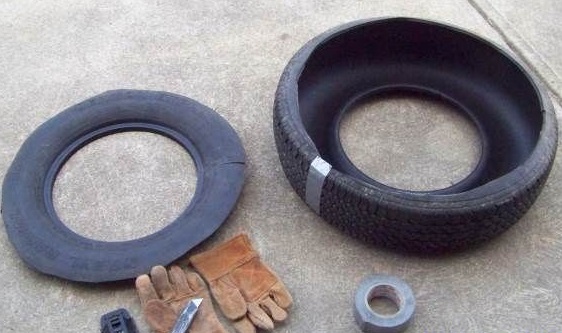
You can see the work he had to do to get the tire tread area cut from the rest of the tire.


This was John's effort to

find the belt separation,

but he was not sucessful.

When I received the tread my experienced eye quickly found the location of the belt separation.

This level of effort on John's part was extraordinary but we got the evidence to prove a belt separation as the reason for the bulge in the tread area.

Now you don't need to go to all this effort as a simple "Free Spin" inspection as seen in this YouTube video will provide the evidence you would need to decide if it is time to replace your tires.

I have recommended that owners of RV trailers do a "Free Spin" inspection once a year or every 2,000 miles. This schedule might line up with when you inspect brakes or re-pack the wheel bearings so the Free Spin is not any additional effort and if you discover a wobble or bulge in your tire you know that it's probably time to replace it rather than wait for it to come apart on the side of the Interstate.